5 criteria to evaluate a LEGO leak before getting excited
Not all LEGO leaks are equal. Some turn out to be exact down to the number — that's the case of the Donkey Kong Arcade, confirmed in August 2026 with the same piece count as the July leak. Others never hold up. Here's the reading grid to tell the two apart before the official announcement.
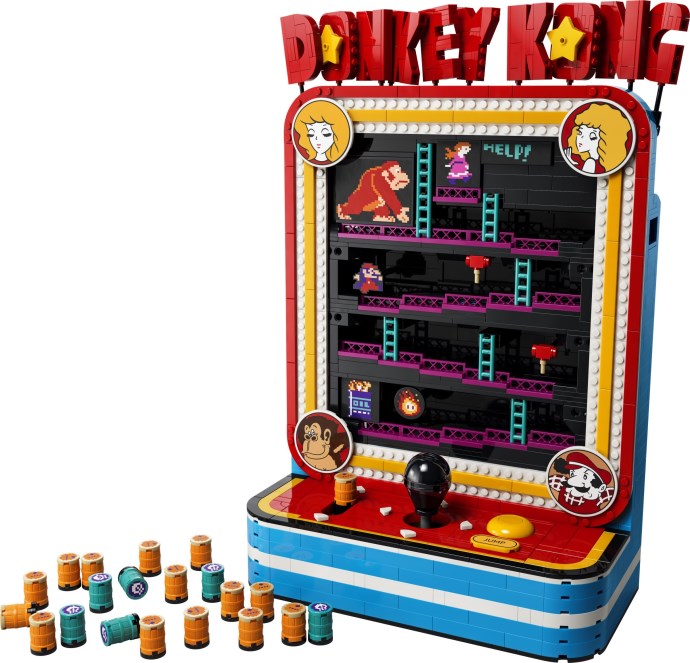
In July 2026, a community leak announced a LEGO Donkey Kong Arcade set around $200, 1,367 pieces, with a rumored early-August release. We had treated the information carefully, never presenting it as an announcement. On August 1, 2026, LEGO officially revealed the 72051 Donkey Kong Arcade: 1,367 pieces — the exact figure from the leak — priced at 169.99€ in France ($199.99 in the US). A textbook case to validate a reading method, rather than a list of abstract rules.
Leak (July 14, 2026)
≈200 $ · 1 367 pcs
Confirmed (Aug 1, 2026)
169,99 € · 1 367 pcs
Piece count gap
0
Verdict
Exact leak
The 5-criteria grid
1. Primary source or just a relay?
A leak coming from official data accidentally exposed — a retailer's product page published too early, a registered EAN code, visuals on a partner site — carries more weight than a rumor relayed site to site with no one citing its original source. The Donkey Kong Arcade leak was relayed by several specialized outlets (Nintendo Life, 9to5Toys, GameRant), but rested on a community render from the LEGOleak subreddit — not a retailer leak. Its credibility came from elsewhere (see criterion 4).
2. Is the price-per-piece consistent with the range?
A figure that strongly deviates from the range's usual price-per-piece is a red flag — either a data entry error on the leak's side, or a fabrication. Conversely, a price that falls within the range's normal bracket strengthens credibility without proving it. The Donkey Kong Arcade leak mentioned ~$200 for 1,367 pieces, i.e. ~$0.146/piece — consistent with LEGO Super Mario/Nintendo interactive sets of that era, neither abnormally low nor abnormally high.
3. Official visual or a doctored render?
A fan-made render almost always gives itself away: inconsistent shadows, LEGO colors that don't match any official shade, approximate minifig proportions. For the Donkey Kong Arcade, no official image existed at the time of the leak — only unofficial renders circulated. Our article from that period took care not to show any fabricated visual, using instead a callout acknowledging the absence of an official image: the right practice remains never presenting an unofficial render as an image of the final product.
4. Was there prior official teasing?
Prior official teasing before the leak — even vague — is one of the most reliable signals. LEGO and Nintendo had briefly teased a Donkey Kong collaboration as early as May 2026, before the leak even circulated. A studio or license that has already let an official intention slip makes the following leak notably more credible than a rumor appearing with no prior anchor at all.
5. What's the track record of the source relaying it?
Some leak-tracking communities (like Brick Tap, cited in 2026 for a massive 40-set leak confirmed via a French retailer's product page) have a track record of leaks that hold up. Others relay everything circulating without any filter. Before treating a leak as reliable, check whether the source has a history of verified predictions — not just published leaks.
What the Donkey Kong Arcade case proves
On the five criteria, the Donkey Kong Arcade checked prior official teasing (criterion 4) and a price-per-piece consistent with the range (criterion 2) — but no primary retailer source (criterion 1) nor an official visual (criterion 3). Result: a partially solid leak, confirmed 100% on piece count and nearly exact on price. It's not a foolproof formula — it's a concrete example of why weighing each criterion individually beats a blanket 'credible' or 'not credible' judgment.
My take
I never treat a leak as an announcement, even when it checks 4 out of 5 criteria — the only case where I'd act financially (preorder, buying related merch) is the official announcement itself. That said, a leak that checks at least the prior official teasing criterion (4) and the price-per-piece consistency one (2) deserves close attention, not dismissal: historically, that's the profile that gets confirmed most often.
How I track this with Cault
I never add a rumored set to my Cault inventory before official confirmation — value tracking only makes sense on an item actually bought or cataloged. Instead, I keep a separate wishlist for leaks that check at least two out of five criteria, which I convert to a real item as soon as the official announcement lands, with the real price and reference.
The takeaway
A leak is neither true nor false by default — it's weighed criterion by criterion. The Donkey Kong Arcade validated the method: prior official teasing and price consistency were enough to predict an exact piece count, even without a retailer source or an official visual. The signal to remember: the more criteria a leak checks, the more it deserves following — but no leak, however solid, replaces the official announcement.
Related articles
L'exclusivité d'une minifig LEGO a une date de péremption — le cas Luke Skywalker et le 75419
Pendant 10 mois, une seule façon d'avoir cette minifig : un set à 999,99€. Un livre DK sorti le 20 août embarque la même figurine — le set reste unique, sa minifig ne l'est plus.
28 août 2026
LEGO One Piece : la vague 2026 coûte 20% plus cher à la pièce que 2025
Vague 2025 : 0,0903€/pièce. Vague 2026 : 0,1083€/pièce. Même licence, un an d'écart. Le duo Chopper/Gum-Gum Fruit illustre l'écart en une image.
27 août 2026
LEGO : même prix de détail, prix Amazon différent — l'écart France/Allemagne sur 5 sets
Prix de détail identique en France et en Allemagne sur 5 sets. Prix Amazon : de 0% à 22,2% d'écart le même jour, sans lien avec le prix du set.
25 août 2026
Enjoyed this article? Find a summary on our social media — and follow us so you never miss anything.
Cault
Get alerted the moment it's officially confirmed
Cault tracks new LEGO releases and notifies you as soon as a set enters the official catalog.