Gringotts vs Willy Wonka: how to read a LEGO investment projection without getting fooled
Investabrick projects a 66% gain in one year for the Gringotts Wizarding Bank 76417, and 43% for the LEGO Ideas Willy Wonka 21360. Impressive numbers — but what do they actually measure? Here's the mechanics behind these projections, so you can read them without getting fooled by a percentage taken out of context.
Third-party projections (Investabrick, July 2026), shared for informational purposes. Past performance and projections do not guarantee future performance. Do your own checks before investing.
The Gringotts Wizarding Bank 76417 (already sold out in the US, still available for preorder in the UK) and the LEGO Ideas Willy Wonka 21360 are both nearing the end of their retail run. Investabrick assigns both high gain projections, driven in each case by the same logic: the cumulative value of their exclusive minifigures. Understanding this mechanic lets you judge whether the number holds up — or mostly captures current hype.
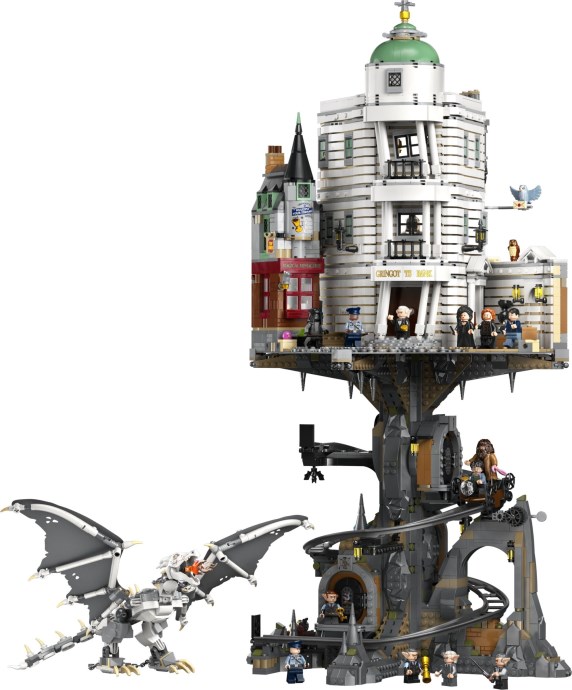
76417 — Gringotts Wizarding Bank

21360 — Willy Wonka
The two sets, side by side
| Set | Minifigs | Minifig value | 1-year projection | 5-year projection |
|---|---|---|---|---|
| 76417 — Gringotts Wizarding Bank — Collectors' Edition | 13 | 195 $ | +66 % | +151 % |
| 21360 — LEGO Ideas Willy Wonka and the Chocolate Factory | 9 | ≈2/3 of the set's price | +43 % | — |
Gringotts — exclusive minifigs
13
Willy Wonka — minifig share of price
≈66 %
Why the minifig, not the box, often drives the real value
On a licensed set, a significant share — sometimes the majority — of resale value doesn't come from the pieces but from exclusive minifigures, unavailable elsewhere once the set retires. That's the case for both sets here: $195 in cumulative value across Gringotts' 13 minifigs, and roughly two-thirds of Willy Wonka's sale price carried by its 9 minifigs. A minifig-based valuation method adds up each figure's individual value on the parted-out market to estimate a value floor, independent of the complete-box price.
How to read a projection without getting fooled
Three questions to ask before trusting a projected gain percentage:
- Is the sellout already confirmed, or only anticipated? Gringotts is already sold out in the US — a fact, not an assumption.
- Does the projection aggregate parted-out value (more stable) or complete sealed-set value (more volatile)?
- Is the 5-year horizon based on real license history, or a linear extrapolation of a 1-year gain?
My decision grid before investing in an EOL set
Before following a projection, I check three things in order: is the sellout confirmed on the primary market (not just a rumor), does minifig value represent a significant and verifiable share of the set's price, and is there a comparable precedent on the same license. Gringotts checks all three boxes. Willy Wonka checks the first two, but has no direct precedent on a Roald Dahl license at LEGO — hence no 5-year projection in the available data.
The takeaway
A projected gain percentage only has value if you understand what it aggregates. Here, both projections rest on a real mechanism — exclusive minifig value — rather than pure hype. Gringotts, with its already-confirmed sellout and richer license history, has the stronger case of the two at this stage. Willy Wonka remains promising but more speculative, lacking a direct precedent.
Related articles
L'exclusivité d'une minifig LEGO a une date de péremption — le cas Luke Skywalker et le 75419
Pendant 10 mois, une seule façon d'avoir cette minifig : un set à 999,99€. Un livre DK sorti le 20 août embarque la même figurine — le set reste unique, sa minifig ne l'est plus.
28 août 2026
LEGO One Piece : la vague 2026 coûte 20% plus cher à la pièce que 2025
Vague 2025 : 0,0903€/pièce. Vague 2026 : 0,1083€/pièce. Même licence, un an d'écart. Le duo Chopper/Gum-Gum Fruit illustre l'écart en une image.
27 août 2026
LEGO : même prix de détail, prix Amazon différent — l'écart France/Allemagne sur 5 sets
Prix de détail identique en France et en Allemagne sur 5 sets. Prix Amazon : de 0% à 22,2% d'écart le même jour, sans lien avec le prix du set.
25 août 2026
Enjoyed this article? Find a summary on our social media — and follow us so you never miss anything.
Cault
Calculate your sets' value, minifigs included
Cault includes the price of embedded minifigs in each set's value calculation, automatically.