LEGO 11377 Minas Tirith — The White City, the hype and the investment potential
8,278 pieces, €649.99, the largest LEGO Lord of the Rings set ever released. Why the 2026 event is driving the community wild — and what a clear-headed collector-investor should take away.
Published June 1, 2026 · Insiders launch day
Buy on LEGO.com — €649.99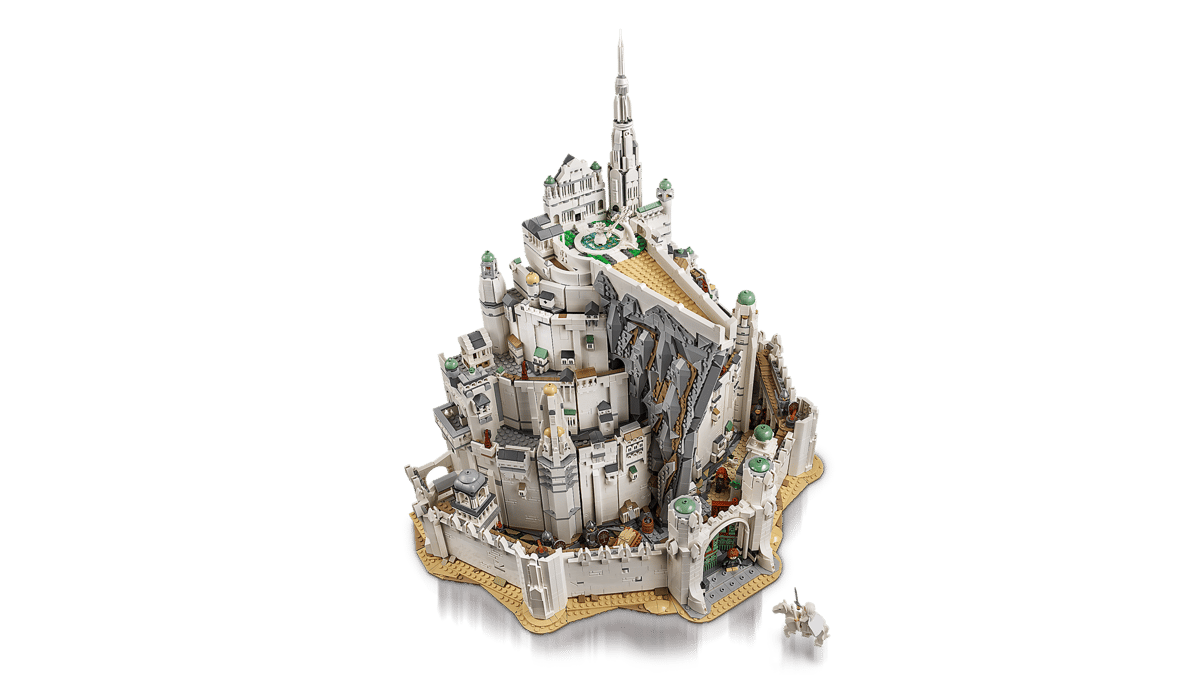
"The beacons are lit, Gondor calls for aid." That's roughly the phrase all LEGO media echoed in unison at the announcement. And honestly — they're not wrong. This June 1, 2026, LEGO finally releases 11377 Minas Tirith, the set the LotR community had been waiting for since 2012. Not just the largest LEGO LOTR ever made — the set thousands of fans had demanded set after set, year after year, with no answer. Until today.
But at €650, emotion has a price. And if you're here to understand what it's really worth — not to be sold a dream — then this article is for you. We'll look the set square in the face: what's exceptional, what's overhyped, and what a clear-eyed investor should take away.
Specs at a glance
Pieces
8 278
EU Price
649,99 €
UK Price
579,99 £
US Price
649,99 $
Price / piece
~7,85 c€
Minifigures
10 + Gripoil
Dimensions
59 × 62 × 37 cm
Age
18+
Release
June 4, 2026
Theme
Icons / LOTR
Designer
François Zapf
Distribution
LEGO.com exclusive
The set is positioned as a Legacy Collection for the 25th anniversary of The Fellowship of the Ring (2001). Designer: François Zapf, already behind other landmark Icons pieces. Distribution: LEGO.com and LEGO Stores exclusive — no third-party retailers, so no Amazon discounts to expect.
Why such hype?
If you look at the reactions to the announcement — on Reddit, Brickset, YouTube — you quickly understand that this set touches something particular. It's an accumulation of things that each would have been enough to create enthusiasm, but all happening at once.
Thirteen years of waiting is a long time
The first LOTR wave was 2012-2014. Since then, LEGO had released Rivendell in 2023, Barad-dûr in 2024, The Shire in 2025 — but never the White City. Fans had started to doubt it would ever exist. When the set leaked in January 2026 — an embargo error mixed up with Sauron's helmet 11373 — the reaction was instant. The most-liked comment on Brickset at the official announcement: "this is my dream set, I've been waiting 13 years for this." That's the emotional context in which this set arrives.
The technical gamble that divides — and convinces
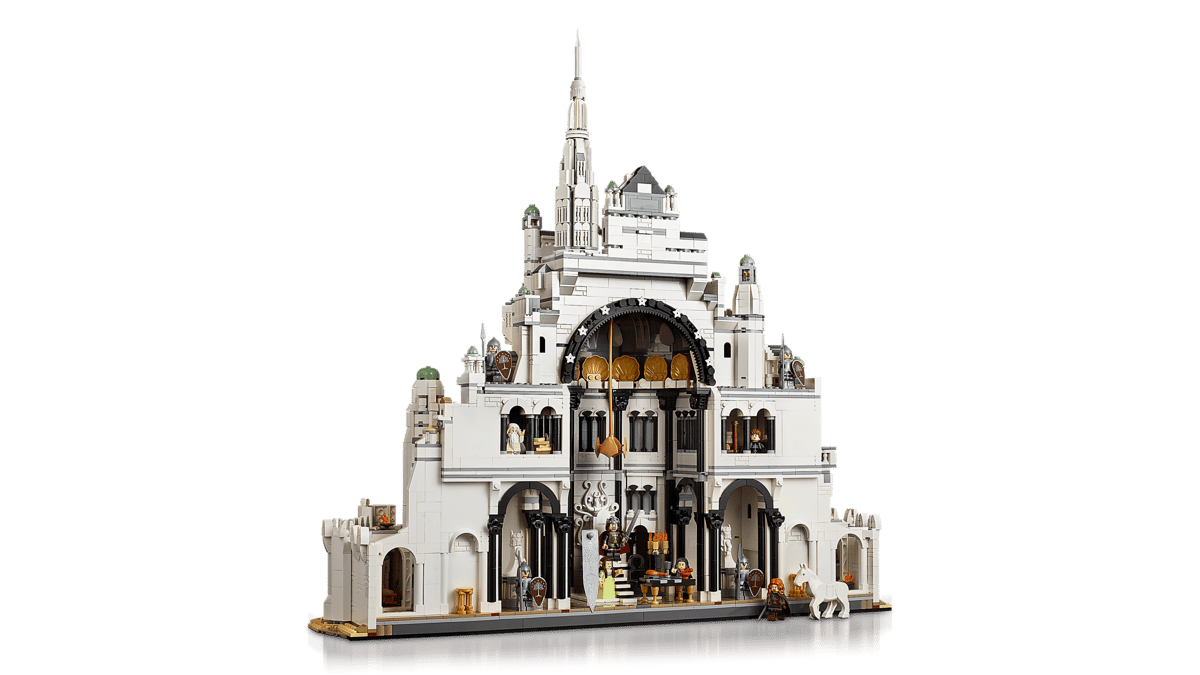
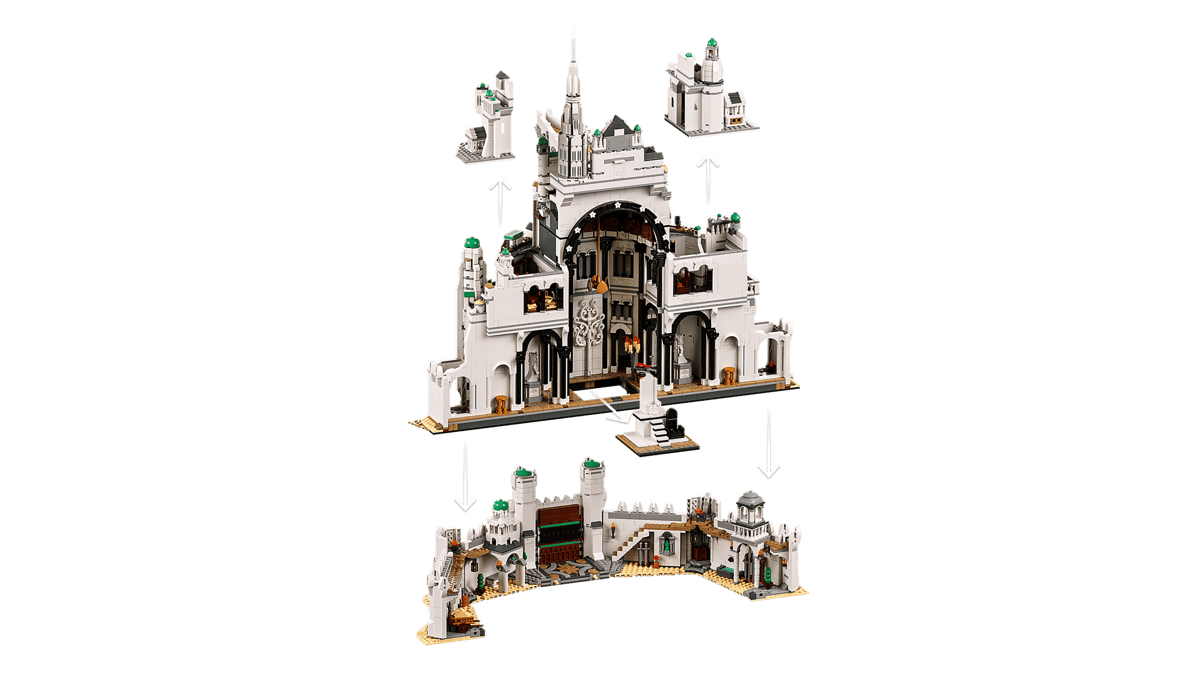
François Zapf made a bold choice: build the city at dual scale. From the front, the White City in micro-scale — its 7 spiral tiers, the Tower of Guard, the white tree. And at the back, a minifig-scale throne room that opens to receive crowned Aragorn, Gandalf the White, Arwen, Denethor… It's not an obvious solution, and some find it hybrid in the pejorative sense. But most reviewers who built the set conclude it works — the object is coherent on display, and the throne room is a real reward at the end of the build.
The GWP Grond — don't overlook it
GWP June 1–7, 2026 — short window
Any purchase of the 11377 between June 1–7, 2026 entitles you, while stocks last, to 40893 Grond — the Orc siege ram (307 pieces, 2 minifigs including an Orc archer head with exclusive olive print). That's a 7-day window only. Historically, GWPs of this scale end up gaining value once they disappear — and this one has a partially exclusive minifig. If you buy in launch week, you get two for the price of one.
Minifig breakdown — where the real value hides
This is the thing most launch articles skim over — probably because piece counts and price make better headlines. But if you're interested in secondary value, this is where it plays out. In Rivendell (10316), the 21 minifigs account for approximately 65% of the set's total secondary market value. Sixty-five percent. In other words, Rivendell is worth what it is mainly because of its figures — not its 6,167 bricks.
Minas Tirith comes with 10 minifigs + Shadowfax — including 2 strictly exclusive ones and several rare characters in the LEGO catalog. The GWP Grond adds yet another exclusive head. Here's the full breakdown, because the details matter:
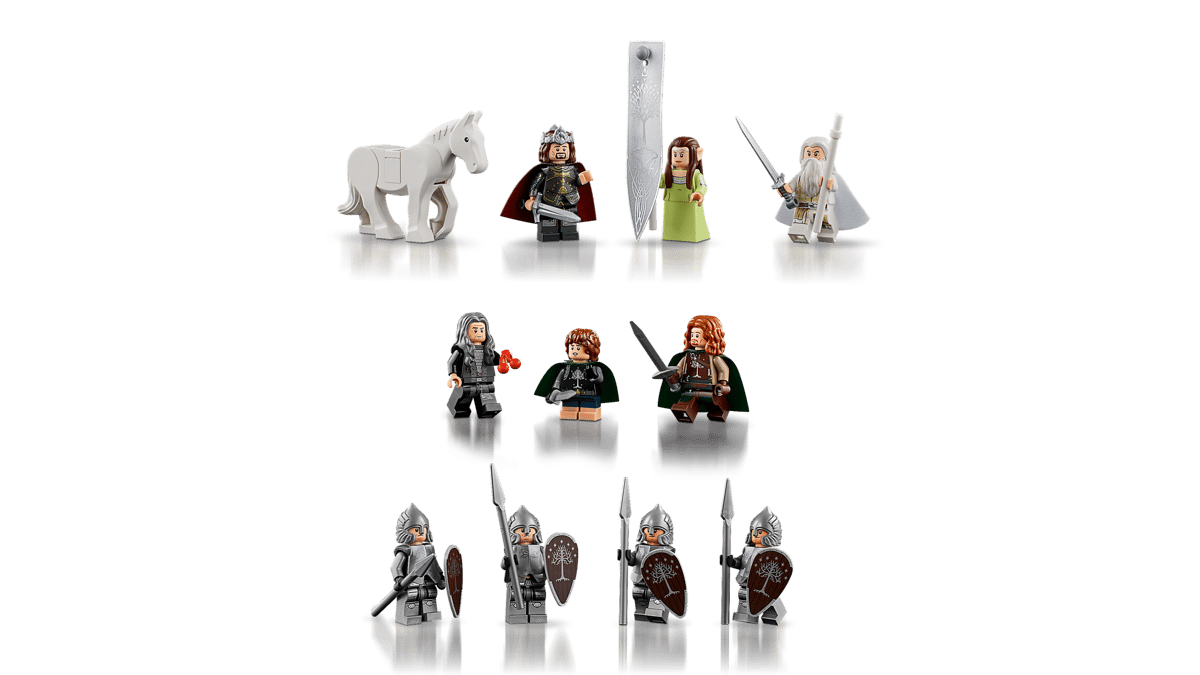
Set 11377 — 10 minifigs + Shadowfax
| Minifigure | Status | Detail |
|---|---|---|
| Aragorn as King Elessar | Exclusive | First appearance in coronation version (Return of the King). Entirely new parts: unique hair+crown mold, golden armor printed torso, double-sided red/black cape, two new head prints. Landmark piece. |
| Gandalf the White | Exclusive | Unique white-bearded face exclusive to this set. The only other Gandalf the White in LEGO since 79007 Battle at the Black Gate (2013) — which trades today at a high price on the secondary market. |
| Arwen | Rare | Rare character in the LEGO catalog. Variant to be confirmed in detail. |
| Faramir | Rare | Rare minifig appearance. |
| Denethor | Rare | Rare minifig appearance. |
| Peregrin (Pippin) Took | Rare | Set-specific variant, to be confirmed. |
| 4× Gondor Soldier | Reused | Likely based on existing molds. Army-building appeal for dioramas. |
| Shadowfax (horse) | Rare | Animal figure of the lord of all horses. Highly anticipated inclusion by fans. |
GWP 40893 Grond — 2 minifigs
| Minifigure | Status | Detail |
|---|---|---|
| Orc archer (green skin) | Partial | New head: unique double-sided olive print (exclusive to this GWP). Torso and legs reused from 10333 Barad-dûr. |
| Orc (orange skin) | Reused | All components from Barad-dûr 10333. No new elements. |
2
Strictly exclusive
Aragorn King Elessar, Gandalf the White
1
Partially exclusive
Orc archer (GWP)
~65%
Minifig share
in secondary value (ref. Rivendell)
Why Aragorn as King Elessar is the most valuable piece in the set
Aragorn has only appeared 3 times as a minifigure in all of LEGO history. His coronation version (King Elessar) has been awaited since the film's release in 2003 — that's 23 years. This is the first and only occurrence to date, and every part is new: entirely new hair+crown mold, golden armor printed torso, double-sided red/black cape, two new head prints. If one single minifig from this set is to gain significantly in secondary value after retirement, it's this one.
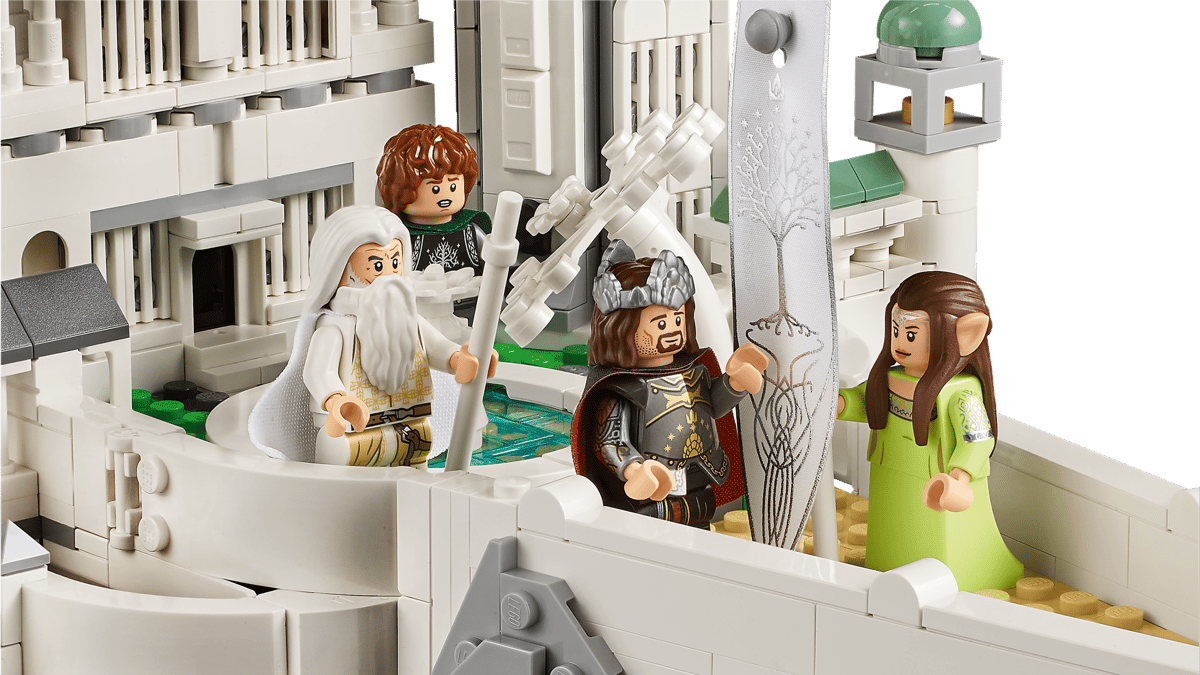
Gandalf the White — the 79007 precedent
The only other Gandalf the White in LEGO was from 79007 Battle at the Black Gate (2013), long retired. That minifig alone regularly trades at high prices on BrickLink. The Gandalf the White from 11377 has a unique white-bearded face print exclusive to this set — it should follow a similar trajectory once Minas Tirith retires.
What it's really like to build and display
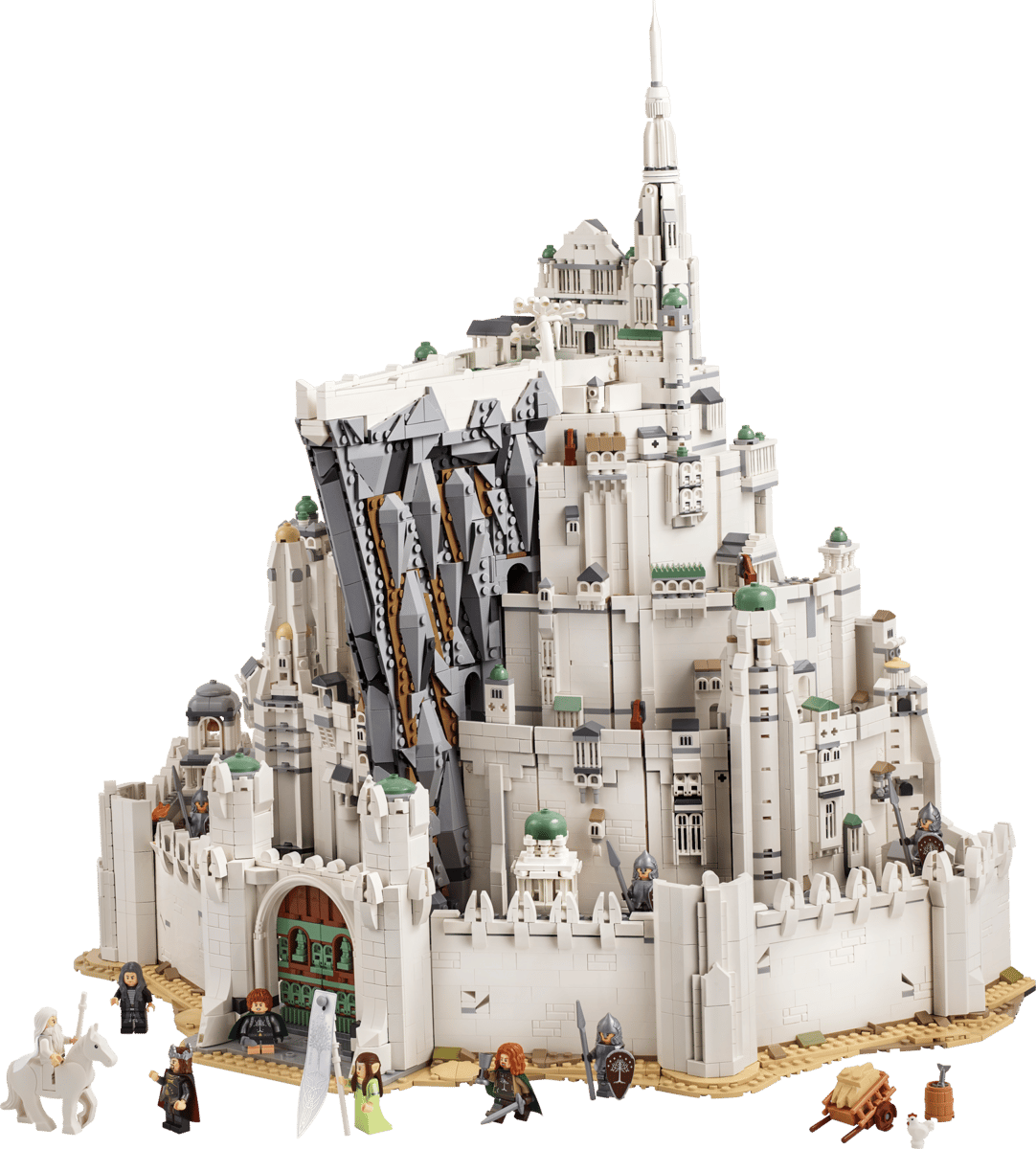
Jay's Brick Blog spent over 15 hours on it. His conclusion: one of the most beautiful sets in recent history, a serious contender for best set of 2026 — while placing it just behind Rivendell in his personal ranking. That 'just behind Rivendell' says something important: this isn't a set that crushes everything else, it's an exceptional set in a catalog that already includes monuments.
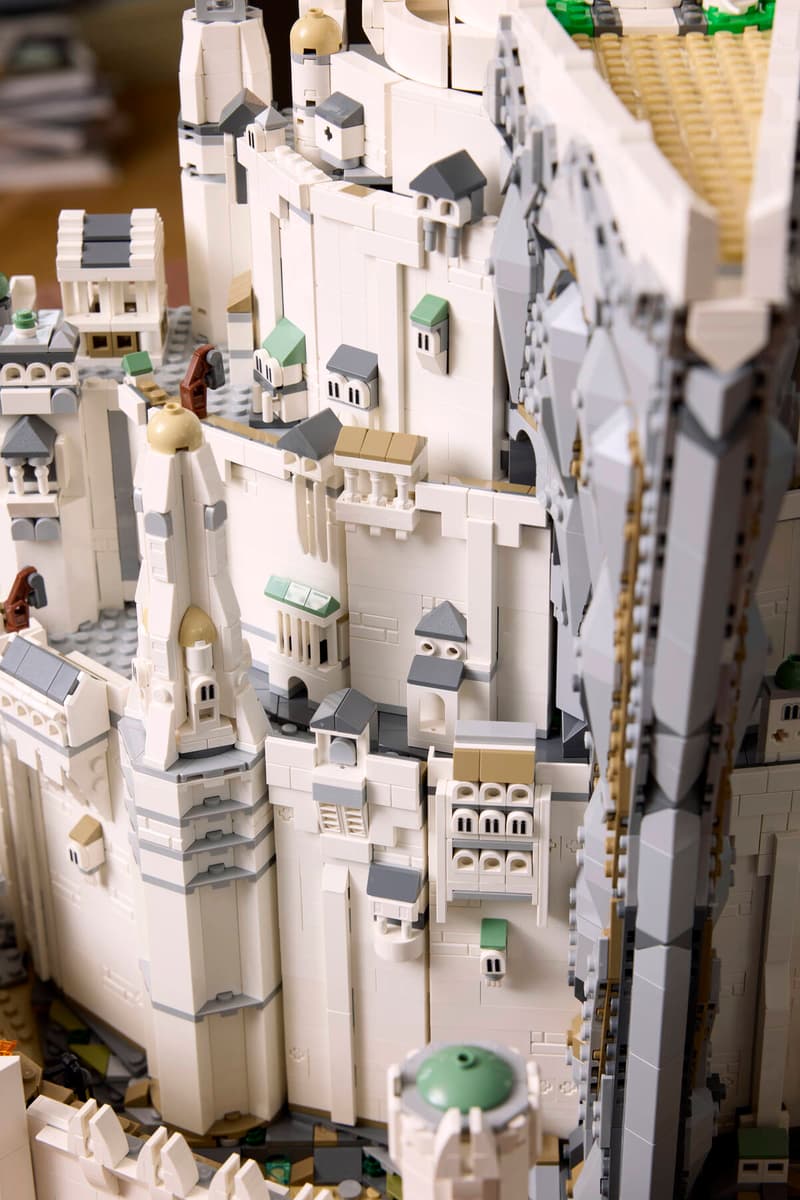
What stands out from reviews is the visual coherence. The 7 spiral tiers of the White City, the Tower of Guard rising above, the white tree of Gondor firmly planted at the center — it all forms an ensemble recognizable from 3 meters away. The colors (off-white, sand beige, light grey) make it more a sculpture than a toy. It's truly designed to be displayed.
- The spiral architecture — faithful to the film, instantly recognizable, beautiful from all angles.
- The white tree of Gondor — the symbolic detail that makes all the difference. Well-proportioned, central, elegant.
- The throne room at the back — where you display crowned Aragorn and Gandalf the White. A welcome build bonus, even if in practice few people show it permanently.
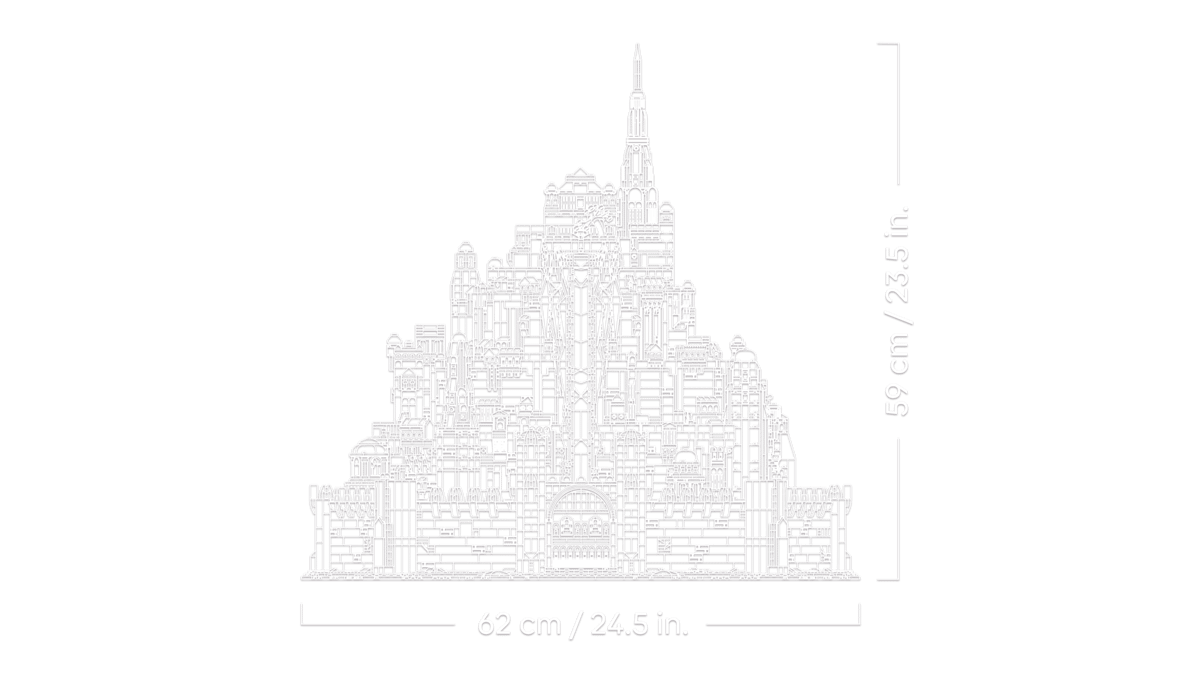
- The manageable size — 59 cm tall, 62 × 37 cm base. Compact in depth vs Rivendell (50 cm). The flat back can go against a wall, saving space on an already full shelf.
For those with multiple flagships to display
Rivendell measures 75 × 39 × 50 cm. Minas Tirith measures 62 × 37 × 59 cm — taller, less deep. If you have both, they complement rather than compete on the shelf. Not a minor detail when talking about €500-650 objects.
Early reviews — what they actually say
Press releases are fine, but what matters is what people who built the set say. Three sources published detailed analyses before and around launch — here's what to take away.
Jay's Brick Blog — the most enthusiastic, with real nuance
15+ hours of building, conclusion: 'among the most beautiful LEGO creations', serious contender for best set of the year. On minifigs: 'LEGO pulled out all the stops' — confirming that even for a reviewer used to seeing large sets, the Aragorn and Gandalf exclusives stand out. Important nuance: he still places Rivendell above it in his personal ranking. An honest concession — and useful for calibrating your expectations.
The Brothers Brick — the reference on minifigs
Their review documented the exclusives most precisely: new molds, unique prints, confirmation that each of the 10 minifigs is a new addition to the LOTR range. If you have a question about a specific figure, that's where you'll find the answer.
Hothbricks — the most useful voice for an investor
Hothbricks is probably the most valuable media if you're looking at this set through an investor's lens — precisely because they don't just celebrate:
Positive point
"Minas Tirith finally raises the bar in terms of finish" — after a recent LOTR wave judged uneven.
Reservation
Dimensions judged "modest" compared to the oversized MOCs fans have been building for years. The rocky ridge at the base is a bit too visible compared to the film aesthetic.
Usage reservation
The minifig-scale "dollhouse" back is probably rarely displayed permanently. It's more a build bonus than a true second face of the set.
Price criticism
The skeptical tone on price recurs several times: "especially for €650". The proposition is judged good but not exceptional relative to the price.
The valuable subtext for an investor
Hothbricks contextualizes Minas Tirith in the modern LOTR wave: Rivendell (2023) 'sets the bar very high', Barad-dûr (2024) 'less exciting', and above all The Shire (10354, 2025) is judged 'disappointing' with 'sloppy finish for the price' and a 'crude' green hill.
Why does this matter? Because a disappointing Shire in 2025, immediately followed by a Minas Tirith that 'raises the bar' in 2026, creates a favorable contrast effect: fans disappointed by The Shire might switch en masse to 11377, supporting both primary and secondary demand. A positive signal that went unnoticed in other analyses.
Our cool-headed takeaway
All three sources agree on the essentials: very good set, not perfect, correct but not exceptional value for money, golden minifigs, successful main model. The back throne room is a build bonus, not a display argument. And Rivendell remains the benchmark of the modern LOTR wave — Minas Tirith comes just below, which is already remarkable.
What the LOTR market tells us
Before talking about potential, we need to look at what already exists. Three sets serve as reference:
10316 Rivendell
2023 · 6 167 pcs · 499,99 €Still available, estimated retirement end 2027 (source Brick Ranker)
Closest direct comparable. Minifigs ~65% of total secondary value. To watch as an indicator of the modern LOTR trajectory.
10333 Barad-dûr
2024 · 5 471 pcs · 459,99 €Available
Modern LOTR wave, adult flagship format. Reference for LOTR "villain" sets.
10237 Tour Orthanc
2013 · 2 359 pcs · ~180 €Retired since ~2015
The old LOTR flagship. Current secondary value far above retail — a frequently cited historical reference.
↑ > €600 sealed today
On Rivendell, a counter-intuitive point is worth noting: at time of writing, its secondary value is slightly below retail (around $400 vs a $499.99 retail). That's not a bad sign — it's the norm for any set still available from LEGO. Appreciation only begins after retirement, and often only 6 to 18 months after, once residual stocks are exhausted. This is what we detail in our ROI guide — and it applies exactly the same to Minas Tirith.
The historical reference most often cited remains 10237 Tower of Orthanc — the 2013 LOTR flagship, sold for ~€180 at the time, which today regularly trades above €600 sealed. Exemplary trajectory. But it was built over 10 years, not 18 months.
Investment potential: the 7 signals to read
Rather than giving you a return prediction (which nobody can seriously make on launch day), here are the 7 objective signals that will determine the set's trajectory. Five are clearly favorable, two call for nuance.
LEGO.com exclusive distribution
PositiveNo discounts through third-party retailers (Amazon, etc.). Historically, LEGO.com exclusives retain their value better after retirement.
Lord of the Rings license
PositiveLicense with very high emotional intensity and adult audience (AFOL). The previous LOTR wave (2012-2014) is now among the most appreciated themes in secondary value.
Flagship format 8,278 pieces
MixedVery large sets have slower trajectories: high entry price, restricted secondary market buyers, demanding storage. They typically perform over 5-8 years rather than 2-3.
Multiple strictly exclusive minifigs
PositiveAragorn as King Elessar (first coronation appearance, entirely new) and Gandalf the White (unique print) are strictly exclusive to this set. In Rivendell, minifigs account for ~65% of total secondary value — a precedent arguing for a strong value moat.
25th anniversary of the trilogy
PositiveThe set is positioned as a commemorative product (Legacy Collection). Strong marketing argument that will weigh in the secondary narrative after retirement.
Price-per-piece of ~7.85c€
NeutralConsistent with large Icons sets (Rivendell ~8.1c€, The Shire 10354 ~7.8c€). Neither expensive nor cheap — the difference will be made elsewhere.
Contrast effect after The Shire (2025)
PositiveHothbricks notes that The Shire (10354) was perceived as disappointing in finish relative to its price. Minas Tirith 'raises the bar' — a favorable contrast that may concentrate demand from disappointed LOTR fans on 11377, supporting both primary sales and secondary value after retirement.
The realistic scenario
Aggregating these signals and drawing from recent LOTR comparable trajectories, the most likely scenario looks like this: 2 to 4 years in production (LEGO doesn't retire a €650 flagship quickly), then a 6 to 12-month post-retirement stagnation phase while residual stocks are exhausted, then progressive appreciation over 5 to 10 years — driven largely by the value of exclusive minifigs.
Average annualized returns for LOTR flagships retired for >5 years historically run around 8 to 14%/year, with high dispersion. The LEGO market average over a long study (2,322 sets, 1987-2015) remains above 11%/year. Minas Tirith has, on paper, all the ingredients to target this range — but success is never guaranteed.
Three buying strategies for your profile
To build & display
Buy now
Take advantage of the GWP Grond (June 1-7) and upcoming doubled Insiders points. The value of the object is in the enjoyment, not speculation. You're building the city you've been waiting for since 2003.
To collect
Buy 2 copies
One to build, one sealed "in storage". Classic AFOL/investor approach. Watch for Insiders "double points" promos in the coming months for the 2nd purchase.
To invest only
Wait patiently
Capital tied up 5 to 10 years, careful storage, no hyper-returns in the short term. Buying sealed during the 'double points' phase and waiting for EOL is the most rational strategy.
Quick comparison with other investments
~7-8%/an
CAC 40
30 years, div. reinvested
~4-5%/an
FR Real estate
excl. rent
>11%/an
LEGO (avg.)
2,322 sets, 87-15
Historical return, no guarantee of future performance. LEGO remains an illiquid asset: expect several weeks to sell at the right price, and applicable tax on gains may apply above certain thresholds.
Risks to be aware of
- Market saturation. LEGO now produces several flagships per year. Secondary demand is spread across a wider catalog than 10 years ago, which may temper returns.
- Reissue / variant risk. Commercial success may motivate LEGO to produce a second wave within 4-5 years (intermediate anniversaries, special packaging), which weighs on scarcity. The Aragorn King Elessar mold could notably reappear in a future Battle of the Black Gate.
- Storage and insurance cost. A sealed €650 set takes up ~13 liters in its box, in a dry and temperature-controlled space. Across a portfolio of 10 sets, this is no longer negligible.
- Opening / accident risk. A damaged box loses 15 to 30% of its resale value. For a set with exclusive minifigs, some prefer to open and sell the minifigs separately — a valid strategy but one that destroys the 'sealed set' value.
- Liquidity. Selling a set at €1,000-1,500 takes time: few buyers, verification, delivery. Expect several weeks, sometimes months.
How Cault tracks this set for you
If you buy the 11377, you can add it to your collection today. Cault will then automatically handle:
- BrickLink market price tracking as soon as the first listings appear — for new sealed and used.
- Price history, accumulated day by day, to visualize the value trajectory from the production phase.
- Gross and annualized ROI calculated in near real-time, platform fees included if you enter them.
- Individual minifigs detected automatically: Aragorn King Elessar, Gandalf the White, Arwen, Faramir, Denethor, Pippin, Gondor soldiers — each with its own market price and appreciation curve. Crucial for this set given the weight of minifigs in secondary value.
- Retirement alert as soon as Brickset confirms the EOL date — the key moment that triggers the appreciation phase.
- Insurance report exportable, useful once a set passes €500-1,000 to adjust your home insurance.
Practical tip: if you buy the 11377 between June 1-7, also add the GWP Grond (40893) as a separate item in Cault. It's likely to gain value independently over the coming years, notably thanks to its Orc archer head with exclusive olive print.
Our take, straight up
Minas Tirith has a lot going for it: a highly emotionally charged license, exclusive minifigs that exist nowhere else (Aragorn as King Elessar waited 23 years — that counts), a LEGO.com exclusivity that protects secondary value, a broadly praised design, and perfect timing — the 25th anniversary of the trilogy, right after a disappointing 2025 Shire that frustrated part of the community. All of this is real and favorable.
But let's be honest: it's not a perfect set either. €650 for dimensions some find modest, a back throne room that won't be on permanent display, and Rivendell still ranking above it with the most respected reviewers. If you're waiting for the LEGO revolution of 2026, this may not be where it happens. If you're looking for a beautiful object with a serious investment profile — then yes, the 11377 checks almost every box.
On the investment side, be clear with yourselves about the horizon: we're talking 5 to 10 years, not 18 months. Capital tied up, careful storage, low liquidity. If you buy hoping to resell at a profit in 2 years, the odds are against you. If you buy with a long horizon and you'd love it regardless — it's one of the best sets to add to your portfolio in 2026.
And if you buy it simply to build it, display it and relive The Return of the King brick by brick — with crowned Aragorn in the throne room and Gandalf the White at his side? That's probably the best reason of all. And 13 years of waiting certainly deserved this.
This article does not constitute investment advice. Historical returns are not indicative of future returns. The LEGO secondary market is illiquid and subject to applicable taxation.
Sources
- Jay's Brick Blog — review LEGO 11377 Minas Tirith
- The Brothers Brick — minifigs et exclusivités du 11377
- Hothbricks — analyse critique Minas Tirith 11377
- Brickset — fiche set 11377-1
- BrickLink — cotations marché 11377
- BrickLink — 79007 Battle at the Black Gate
- Brick Ranker — historique de valeur 10316 Rivendell
- LEGO.com — fiche produit officielle 11377
- Reddit r/lego — réactions communauté à l'annonce
Cault
Track Minas Tirith in your portfolio
Near real-time BrickLink prices, value history, annualized ROI, individual minifig tracking (Aragorn King Elessar, Gandalf the White…), retirement alert. Free to start.
Related articles
L'exclusivité d'une minifig LEGO a une date de péremption — le cas Luke Skywalker et le 75419
Pendant 10 mois, une seule façon d'avoir cette minifig : un set à 999,99€. Un livre DK sorti le 20 août embarque la même figurine — le set reste unique, sa minifig ne l'est plus.
28 août 2026
LEGO One Piece : la vague 2026 coûte 20% plus cher à la pièce que 2025
Vague 2025 : 0,0903€/pièce. Vague 2026 : 0,1083€/pièce. Même licence, un an d'écart. Le duo Chopper/Gum-Gum Fruit illustre l'écart en une image.
27 août 2026
LEGO : même prix de détail, prix Amazon différent — l'écart France/Allemagne sur 5 sets
Prix de détail identique en France et en Allemagne sur 5 sets. Prix Amazon : de 0% à 22,2% d'écart le même jour, sans lien avec le prix du set.
25 août 2026
Enjoyed this article? Find a summary on our social media — and follow us so you never miss anything.