LEGO 21065 Sagrada Família — the largest set of all time, and what it's really worth
12,060 pieces, €749.99, zero minifigures. LEGO breaks its own record and chooses Gaudí's masterpiece to do it. We look the set square in the face: what justifies the purchase, what calls for caution, and what a clear-headed collector-investor should take away.
Published June 4, 2026 · Pre-order opening day
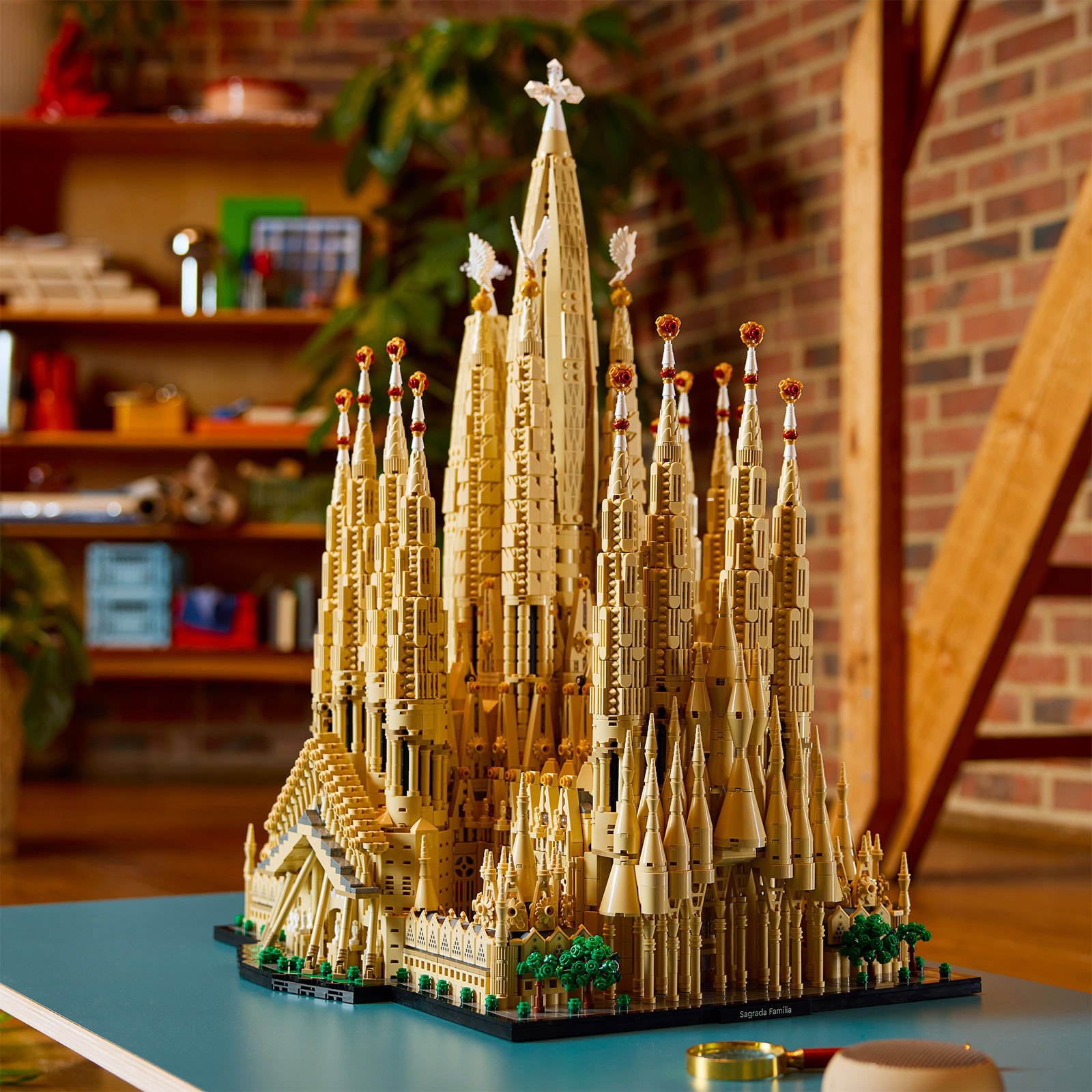
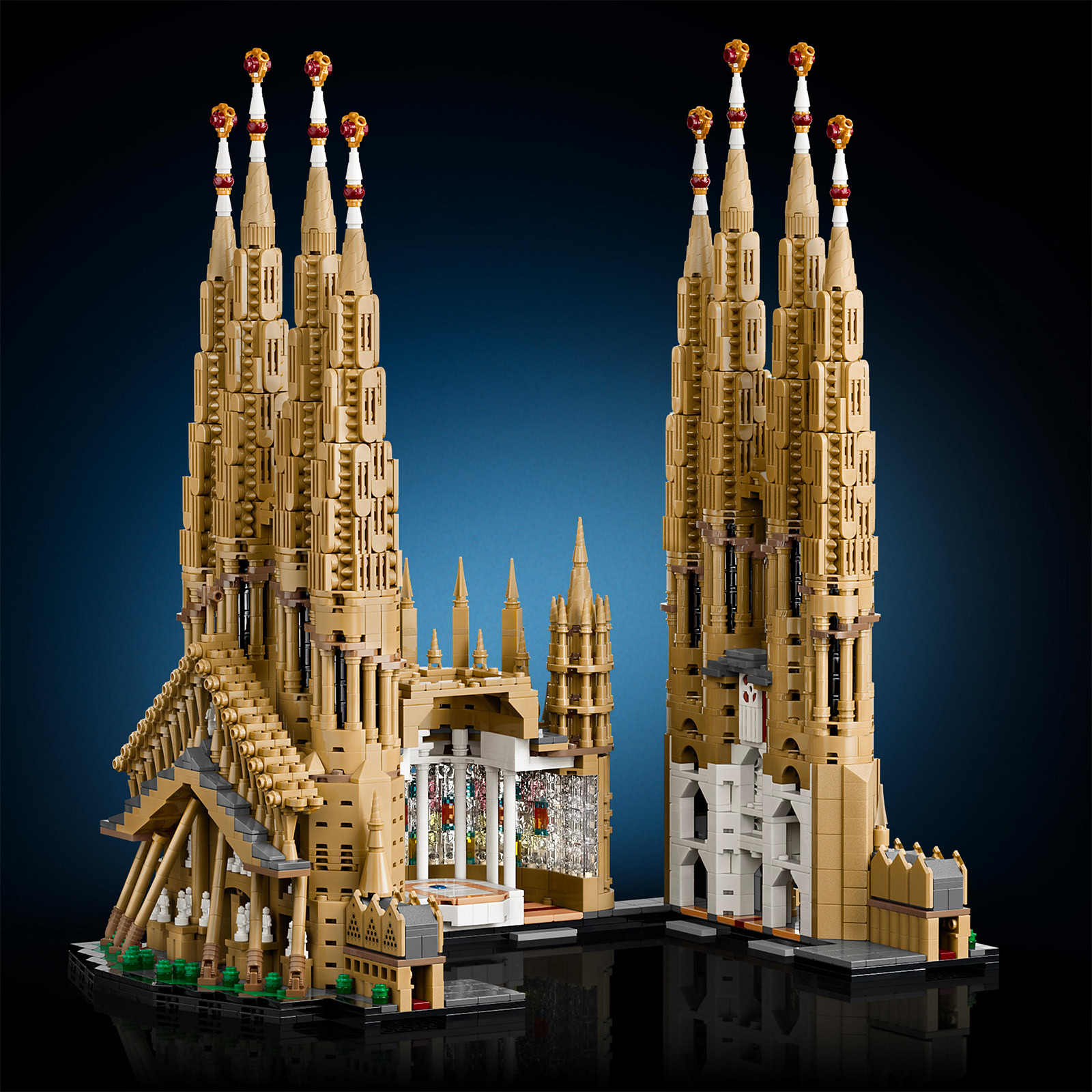
Official LEGO visual. Full gallery on LEGO.com.
On June 4, 2026, LEGO opened pre-orders for a set with an argument nobody can take away from it: it's now the largest LEGO set ever sold. With 12,060 pieces, the 21065 Sagrada Família overtakes the 31203 World Map (11,695 pieces) and sits at the top of the list of the largest sets in brand history. And to claim that title, LEGO didn't choose just any subject: Antoni Gaudí's unfinished basilica, for the centenary of his death.
But at €750, the 'record' argument isn't enough. If you're here to understand what it's really worth — not to be sold a dream — then let's look at this set without complacency. Because unlike a licensed flagship packed with exclusive minifigs, this one plays in a different category, with its own strengths and weaknesses.
Specs at a glance
12 060
Pieces
749,99 €
EU Price
649,99 £
UK Price
799,99 $
US Price
~6,2 c€
Price / piece
0 (Architecture)
Minifigures
62 × 47 × 39 cm
Dimensions
18+
Age
November 1, 2026
Release
Architecture
Theme
Not disclosed
Designer
LEGO.com (wider retail 2027)
Distribution
The set belongs to the Architecture range and takes its micro-scale language: no minifigures, a display model conceived as a sculpture, and an elegant name plaque on the base. Initially announced for July 2026, it was pushed back to November 1, 2026, with a price increase along the way (source Bricksup). LEGO.com and LEGO Stores exclusive at launch — with an opening at selected retailers planned for 2027 (source StoneWars).
Set overview
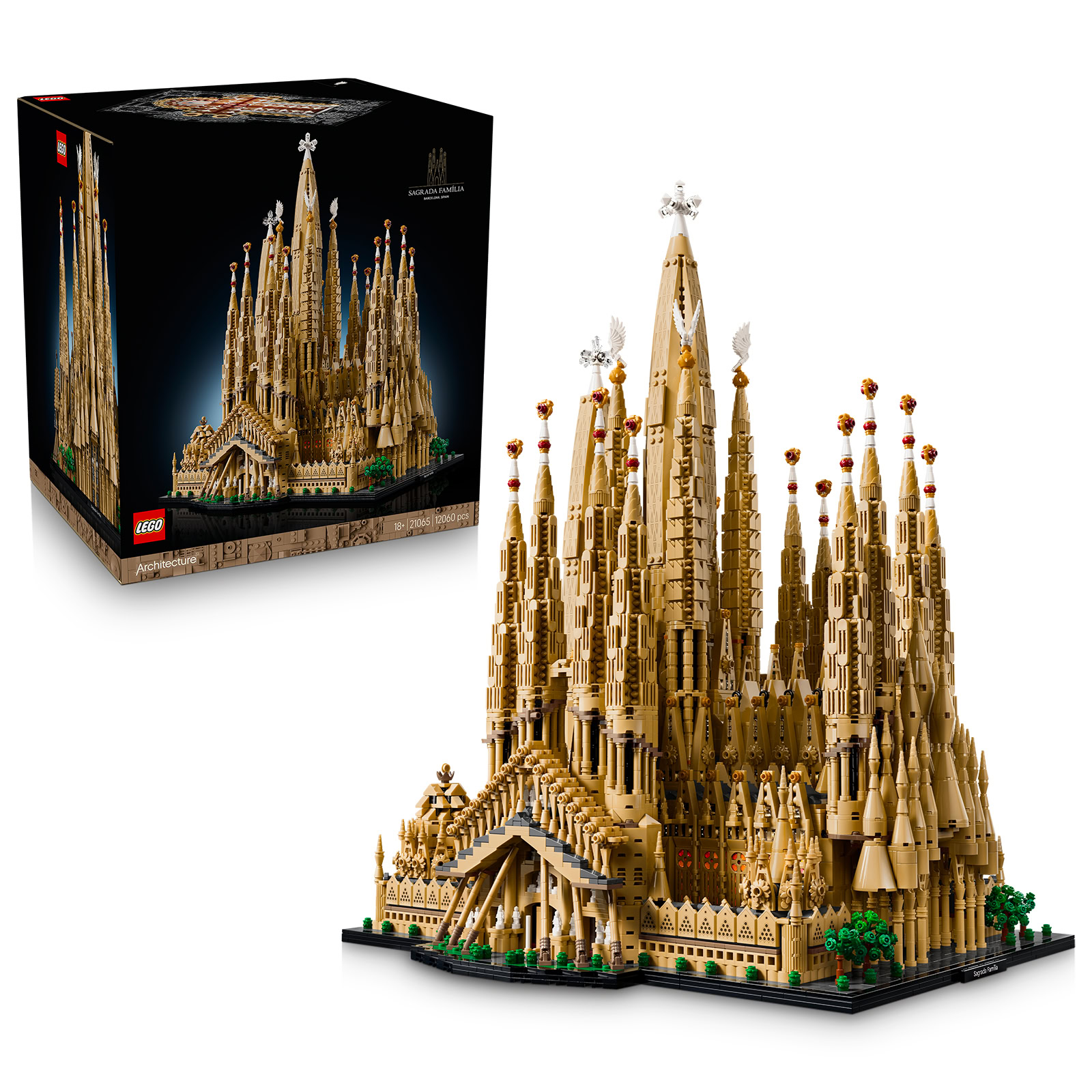
The 21065 is a brick replica of the Barcelona basilica, in Architecture micro-scale. LEGO's key idea: have the builder follow the order of the real construction site. You don't assemble the object in practical blocks, but by reproducing Gaudí's building logic — from the apse to the last towers. The set integrates a stained-glass effect on the windows, a name plaque on the base, and comes with 3D instructions in the LEGO Builder app (zoom, rotation, progress tracking). Pre-order purchase credits 5,625 Insiders points (source LEGO.com).
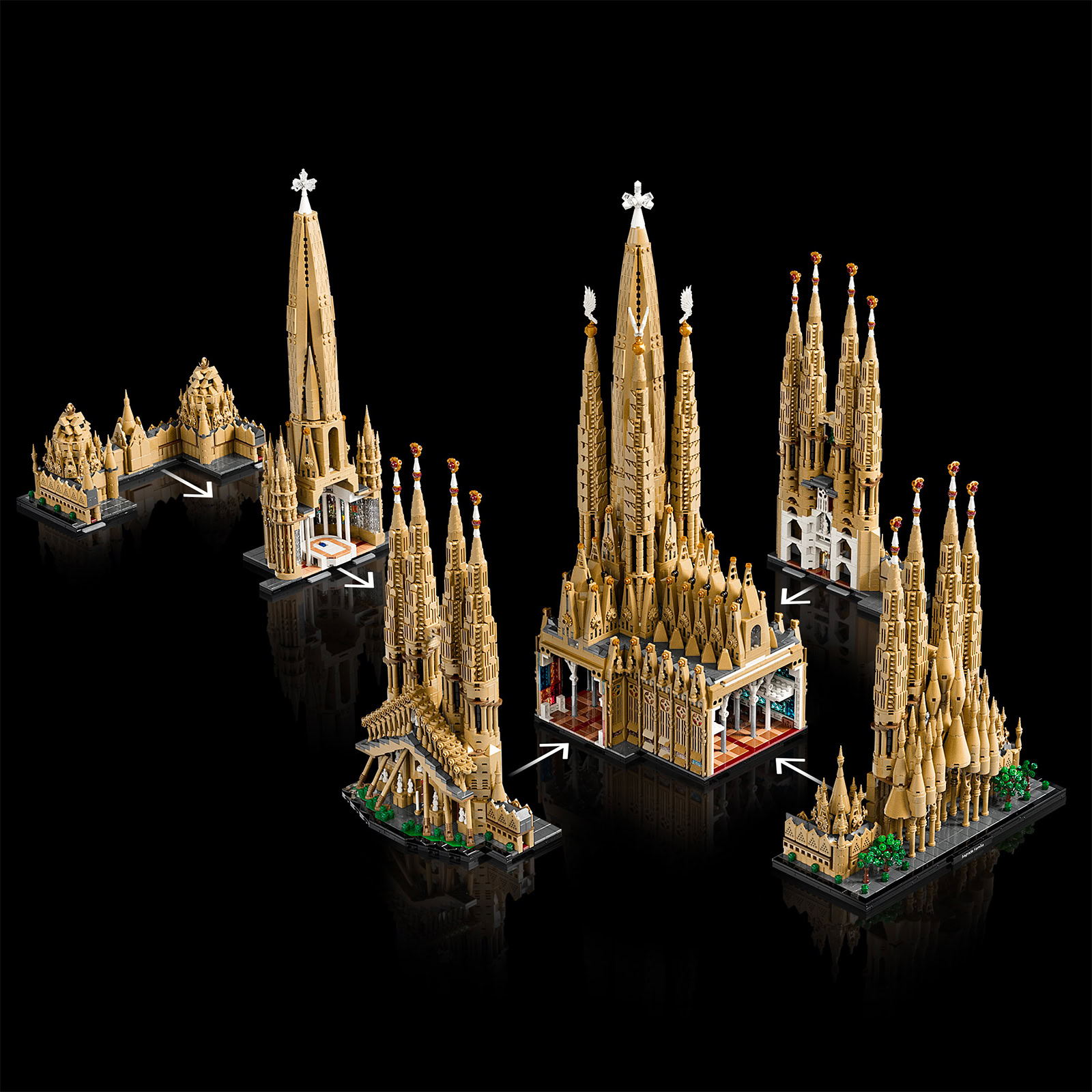
Build stages
The set assembles into several large modules — towers, nave, facades — which are then joined together, following the real building order of the basilica.
- 1
Apse and crypt
The build starts with the heart of the building, as on the real construction site — the base on which everything else rests.
- 2
Nativity Facade
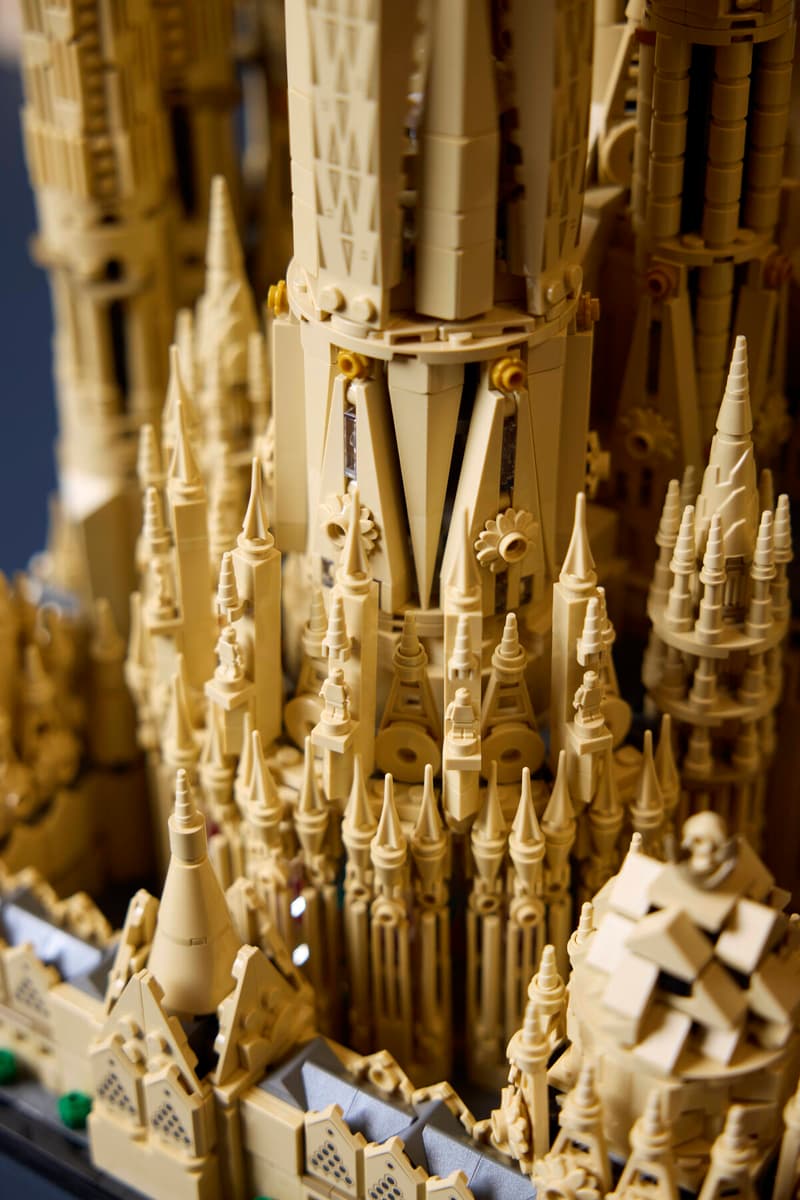
The only facade completed during Gaudí's lifetime, and the most ornate. On the model, it's the part with the most intricate small spires.
- 3
Passion Facade
More austere lines, and above all its characteristic inclined columns — a deliberate contrast with the Nativity, faithful to the real monument.
- 4
Naves and 'forest' interior
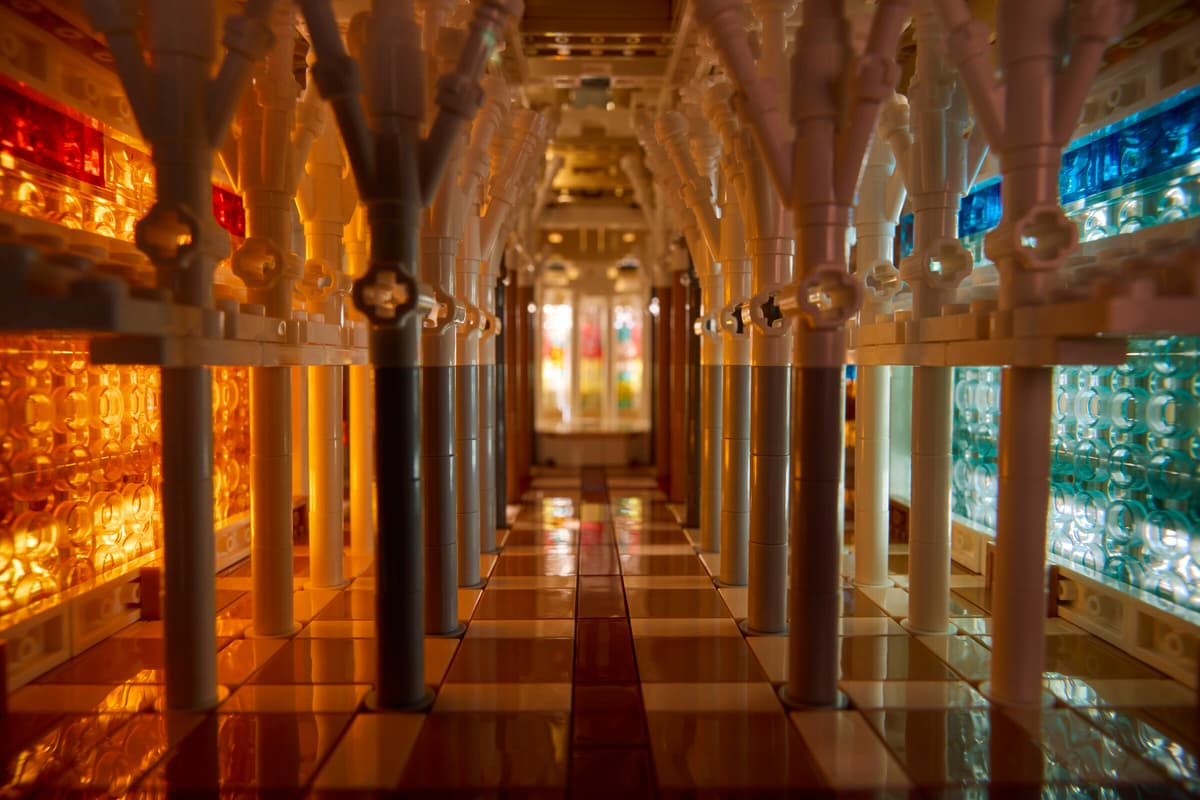
The interior reproduces Gaudí's tree-like columns and a real corridor of translucent stained-glass windows — a module in its own right, visible once the whole is assembled.
- 5
West sacristy, then the towers
The instructions erect 6 main towers; the model evokes all 18 symbolic towers of Gaudí's project. This is the most spectacular moment of the build.
- 6
East sacristy, Glory Facade & plaque
We finish with the Glory Facade (still unfinished on the real monument) and the name plaque on the base — the final touch for display.
Gallery
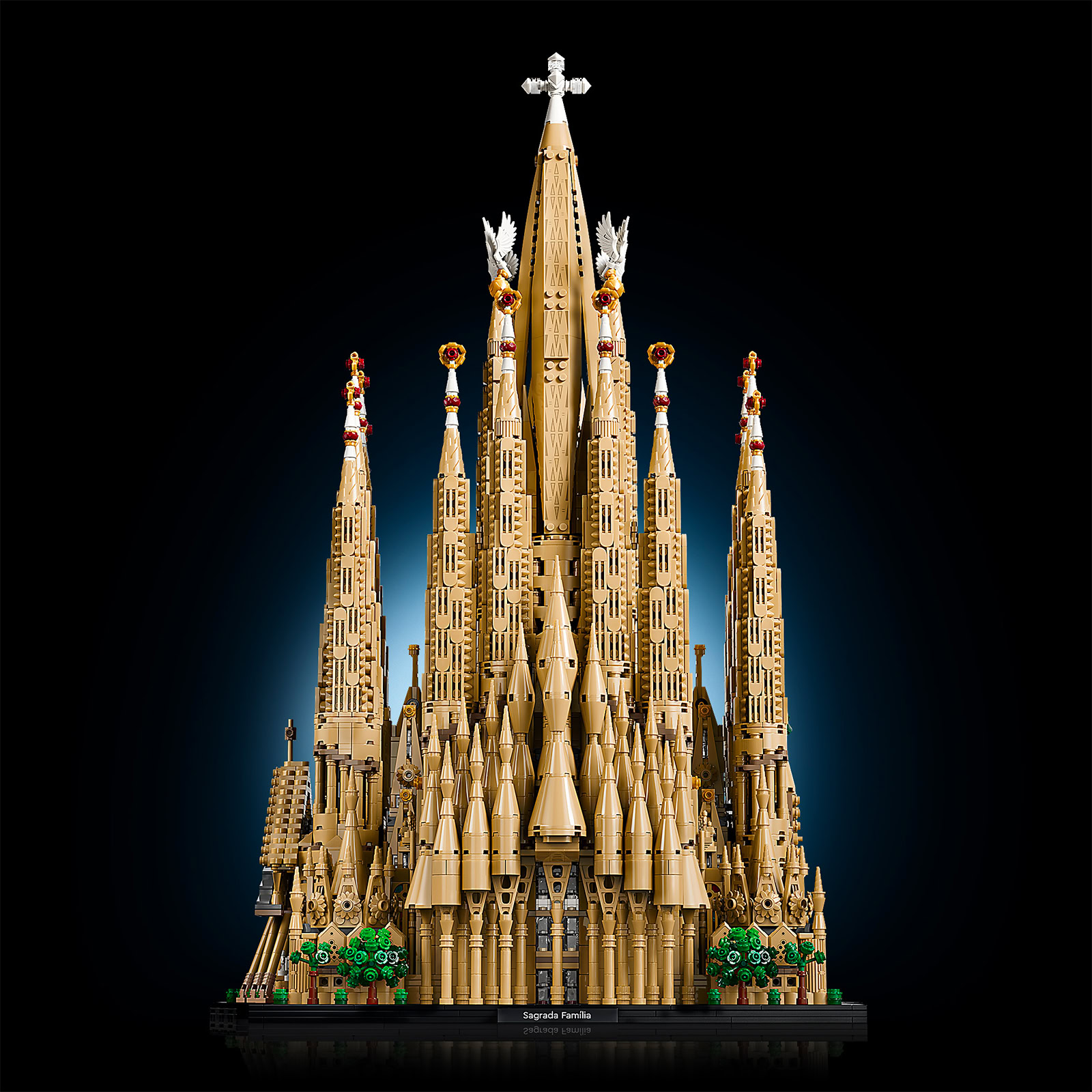
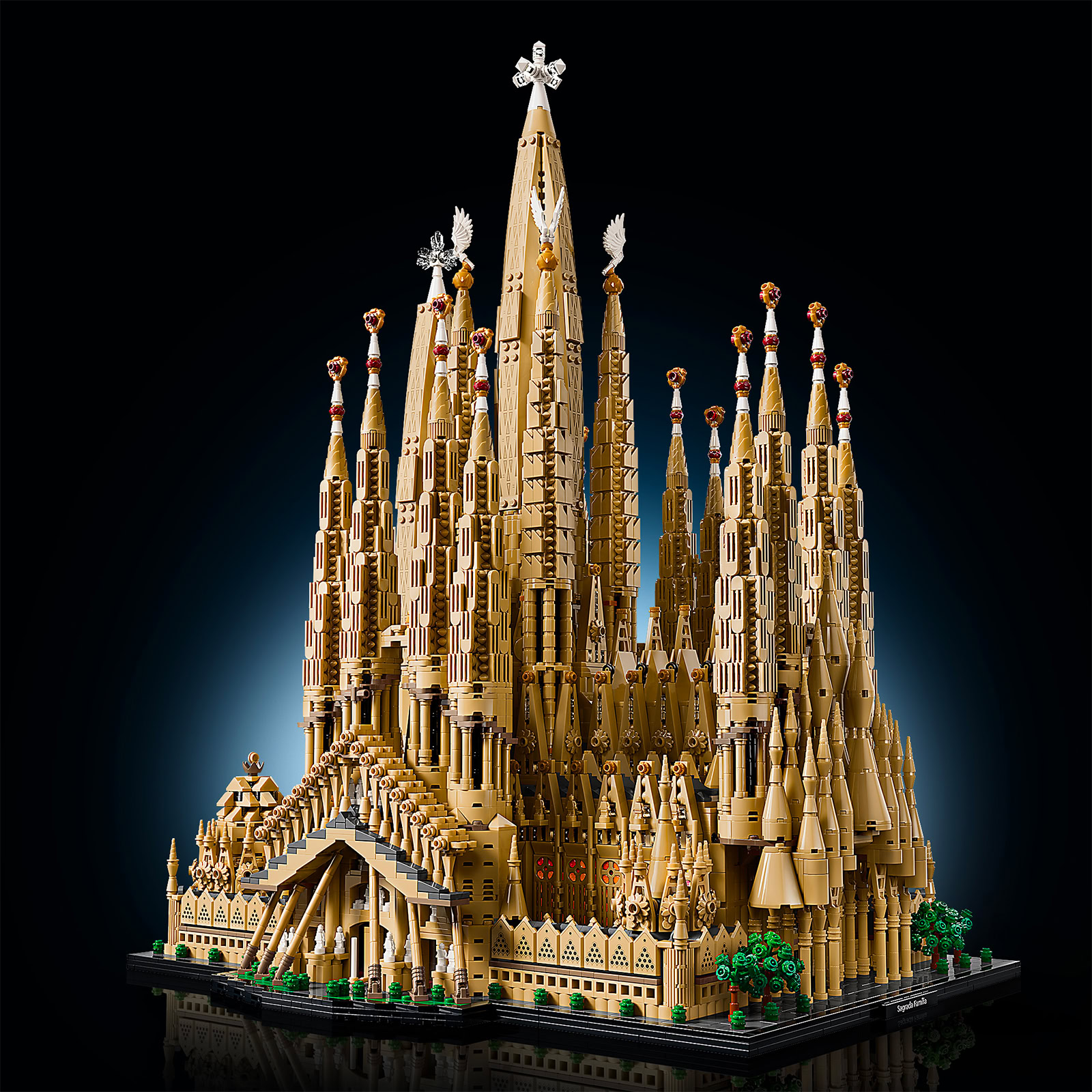
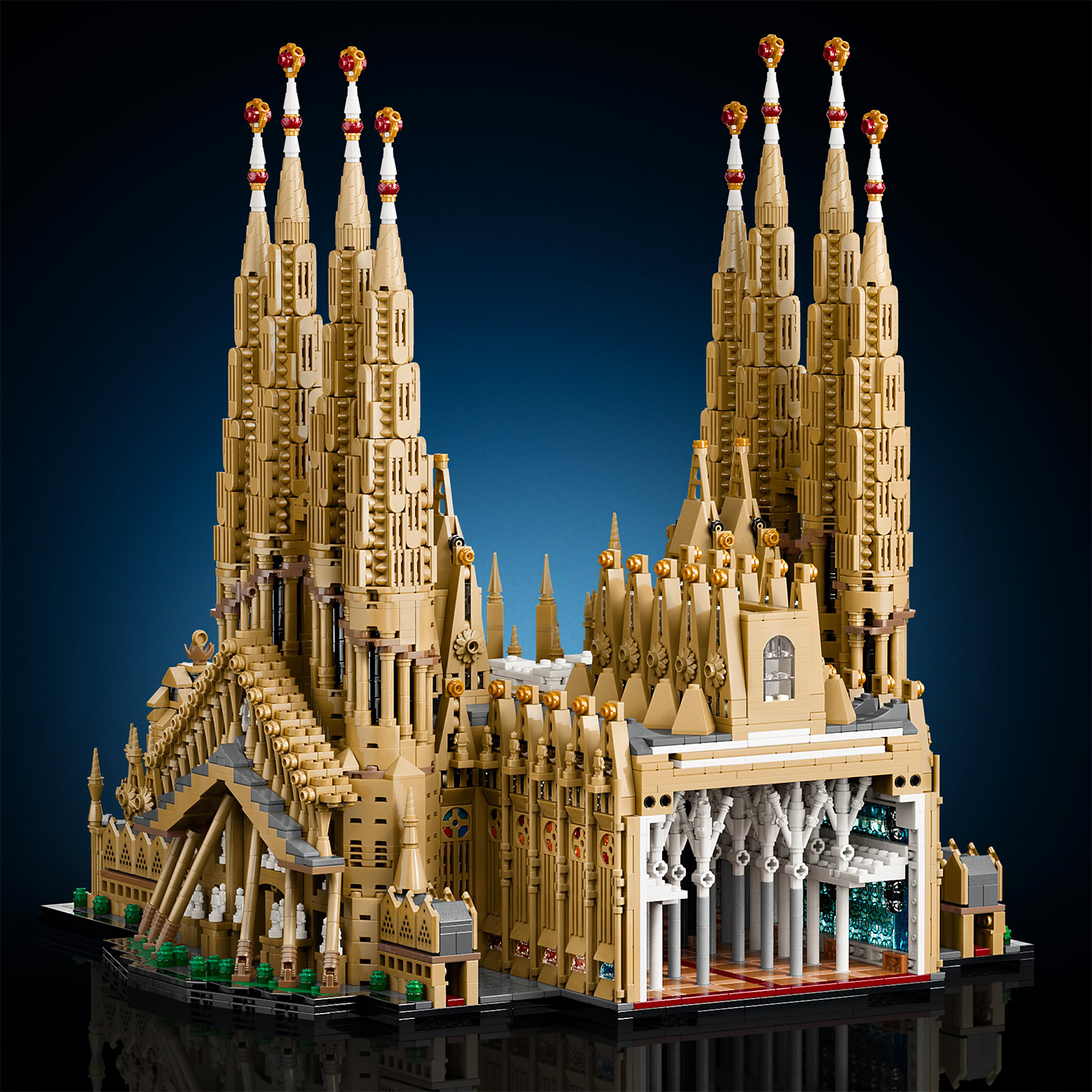
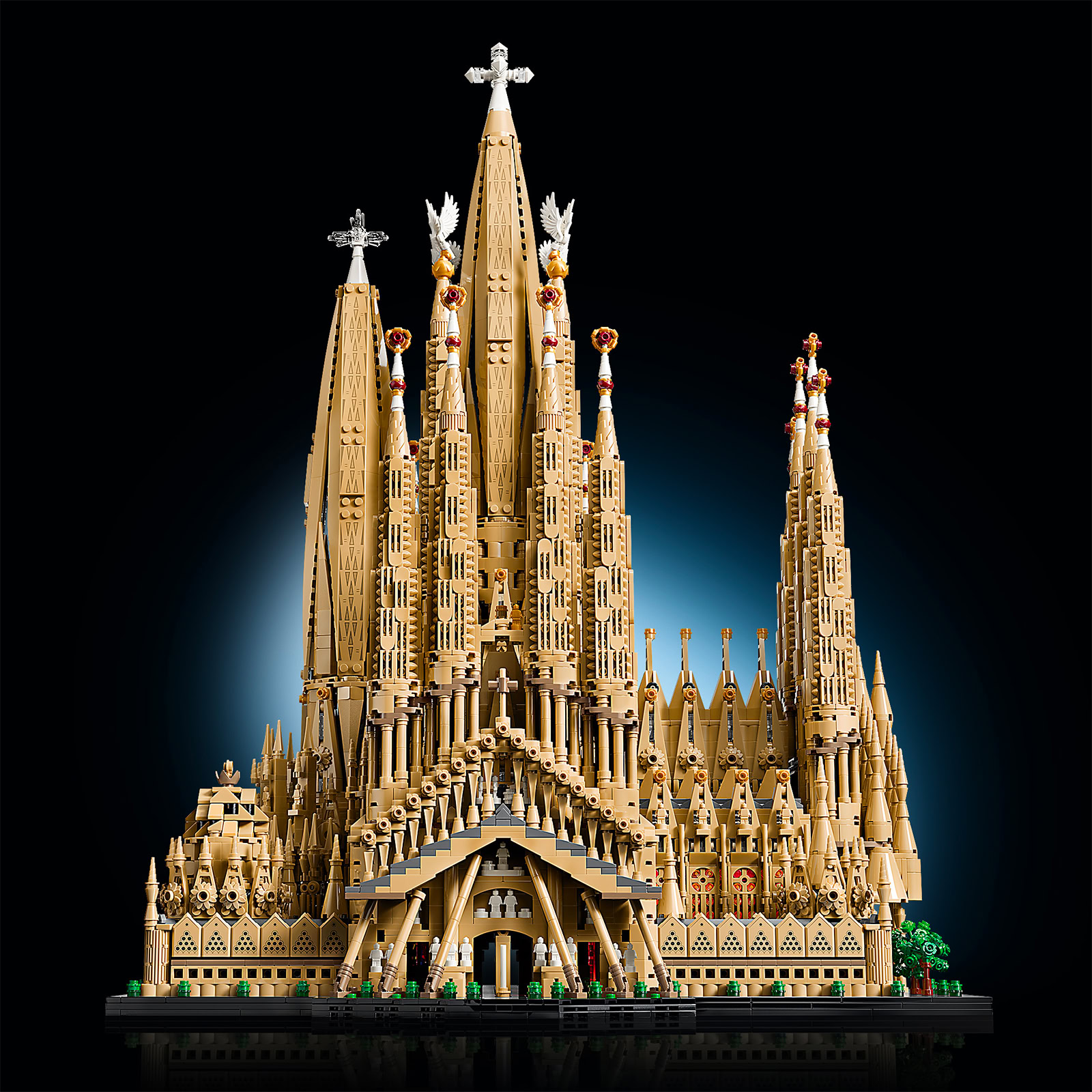
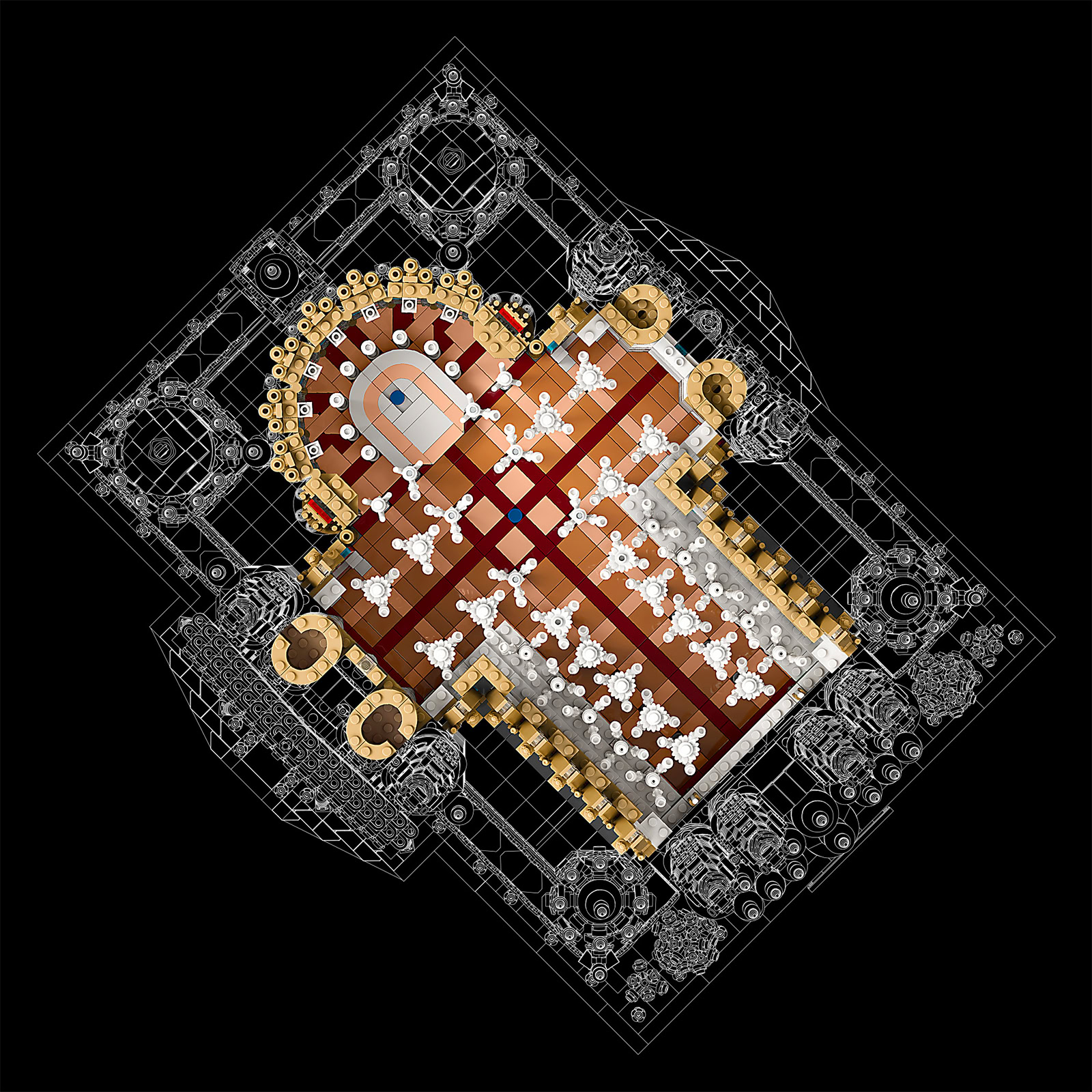
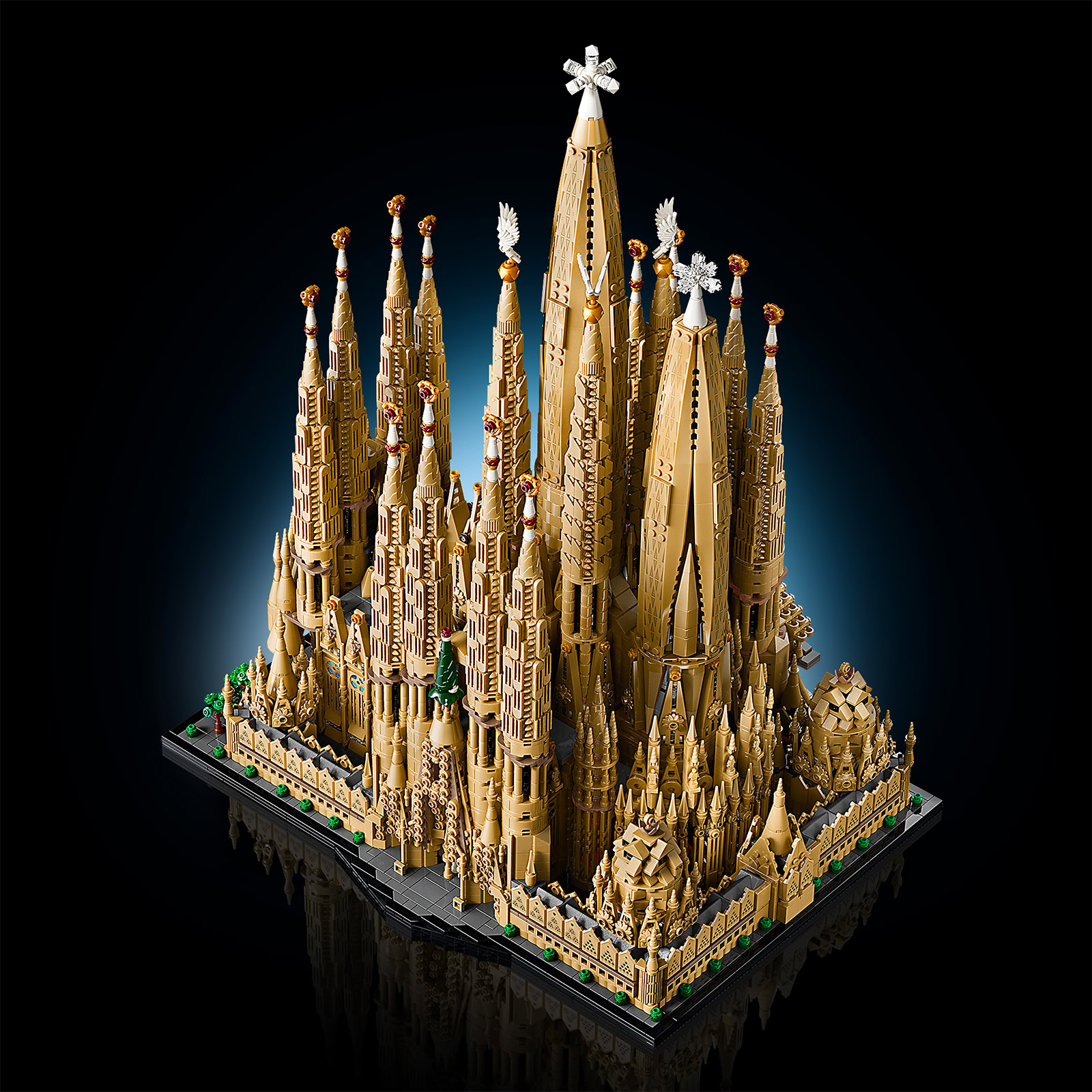
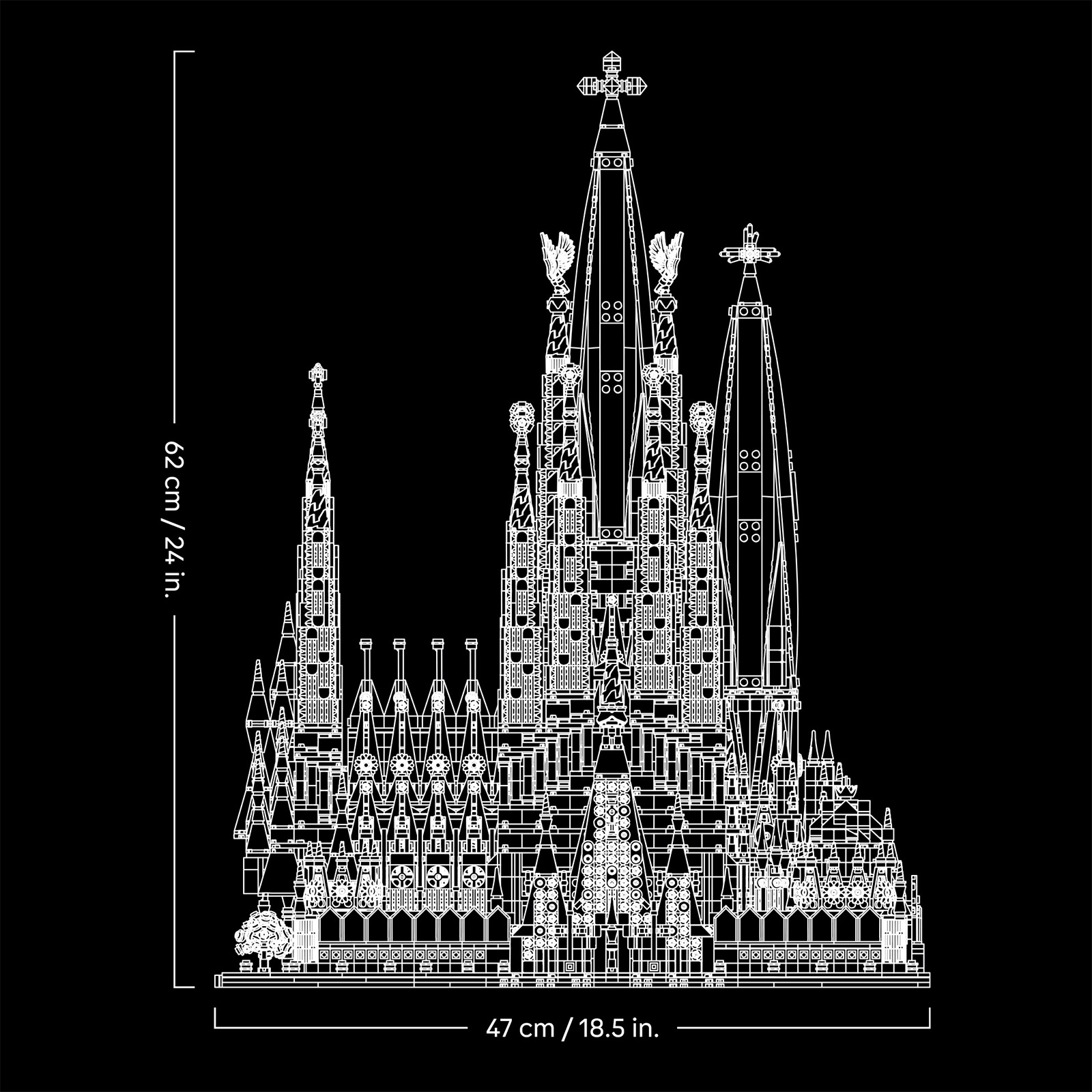
Official LEGO visuals · hosted on site.
Why this set is making waves
The record, plain and simple
Virtually all LEGO media headlined the same point: it's the new largest set of all time. Jay's Brick Blog captures the tone well, quipping that at least with this kit you won't have to wait 144 years to finish it — a nod to the real basilica construction site, still unfinished. The set captures the iconic elements of the monument: 18 symbolic towers, three sculpted facades and a column 'forest' interior (source Jay's Brick Blog).
The Gaudí centenary
Antoni Gaudí died in 1926. LEGO therefore positions the 21065 as a commemorative piece for the 100th anniversary of his death. This is exactly the kind of narrative anchor (anniversary, tribute) that weighs in a set's value after retirement.
A build that follows the real construction site
The build reproduces the order of the real construction site: starting with the apse and crypt, then the Nativity Facade — the only part Gaudí completed in his lifetime — and the Passion Facade. Then the naves, west sacristy, towers, then the Glory Facade and east sacristy. The stained glass has a specific 'tinted glass' effect (source LEGO.com).
The most useful voice for an investor: HothBricks
HothBricks takes an openly skeptical tone on the utility of a 12,000+ piece model, questioning whether 'the world' really needed such an object — while acknowledging that fans of this type of build will be served (source HothBricks).
The subtext is valuable: this is not a 'unanimous love' set like a LOTR flagship. It's a niche, technical object that speaks first to architecture enthusiasts and build challenge lovers. For an investor, that means a smaller secondary buyer pool — to factor into the calculation.
1ˢᵗ
Largest LEGO set
12,060 pieces, ahead of World Map
0
Minifigure
Architecture range — no minifig moat
~6,2 c€
Price per piece
among the lowest in premium
Our analysis of the set, brick by brick
Let's clarify upfront: no complete build review has been published yet (release November 1, 2026). What follows is our reading of the official visuals — a design opinion, not a build review. But these visuals already say a lot, and some choices merit attention.
The monochrome approach: bold, and polarizing
The first thing that strikes you is that the entire building is in a single sand-beige tone. No stone grey, no gradients: a sandstone monolith. It's a real design choice, and it works — the model reads as a unified sculpture, and relief comes from shadows between the thousands of spires rather than color. The downside: you'll need light. In a poorly lit room, such a monochromatic object can flatten. The only color touches are perfectly placed — the red and gold 'fruits' atop the towers, white crosses and doves, green trees on the base.

The real surprise: the interior
You don't expect this from an Architecture set, yet it's when the model really takes off. LEGO built a true interior: a nave bordered by Gaudí's beloved tree-like columns, a tiled floor, and above all a corridor of translucent stained-glass windows that capture light — warm on one side, cool on the other, exactly like the real basilica. The facades are left partially open so you can look inside. In our view, this is the detail that most justifies the 'exceptional piece' status.
Architectural fidelity is there
For those who know the monument, the key markers are present. The Passion Facade and its characteristic inclined columns are well rendered; the central tower of Jesus dominates the composition, flanked by the evangelists' towers capped with their doves; and the small Nativity scene nestles at the base of the main facade. Seen from above, the Latin cross plan is respected.
Modular assembly and manageable size
The assembly visual is reassuring: you build separate modules (tower clusters, nave, facades) before joining them. For a 12,060-piece build, that's the right approach. On space, a pleasant surprise: at 62 × 47 × 39 cm, the whole thing fits on a table or large sideboard. Where the Eiffel Tower 10307 rose to 149 cm, this record-breaker is surprisingly easy to house — a real advantage for the buyer pool.
Our honest take
Visually, it's one of the most beautiful Architecture sets ever designed — the forest of spires and the glazed interior are superb, and the status of largest LEGO of all time is well earned. But let's be clear about what it is: a connoisseur's piece. Monochrome, no minifig, niche subject, demanding build. If you love Gaudí or architecture, you'll love it. If you're looking at it primarily as an investment, keep a cool head: you buy it because you want to display it, and the resale potential comes as a bonus — not the reverse.
What the 'large sets without minifigs' market tells us
31203 World Map
2021 · 11,695 pcs · €249.99 · 0 minifig
Retired end 2023 — comparable #1
The former piece-count record holder, also without minifigs. Per Brick Ranker, its value has risen +114.8% since retirement; BrickEconomy values a new sealed copy well beyond (+200%). This is the reference trajectory for a 'record without minifigs' set.
10307 Eiffel Tower
2022 · 10,001 pcs · €629.99 · 0 minifig
Available, retirement end 2026
The tallest set ever produced, and the other great premium monument without minifig. Still in production, it trades slightly below retail on the secondary market (-7.2% per Brick Ranker) — illustrating the rule: appreciation only begins after retirement.
As long as a set is still sold by LEGO, its secondary value stays close to, or below, retail. Appreciation only begins after retirement, often 6 to 18 months later — and the 2027 wider retail opening may even push this tipping point further out. This is what we detail in our ROI guide.
Investment potential: the 7 signals to read
Four favorable, three nuanced — this is precisely the balance that distinguishes the 21065 from a licensed flagship.
Status of largest LEGO set ever produced
PositiveWith 12,060 pieces, the 21065 dethrones the 31203 World Map (11,695 pieces) and becomes the largest LEGO set in history by piece count. This 'record' status is a powerful and lasting collection argument, independent of any license — it will remain true until a larger set is released.
Centenary of Gaudí's death (1926-2026)
PositiveThe set is launched for the 100th anniversary of Antoni Gaudí's death. Like commemorative sets (license anniversaries), this 'landmark piece' dimension feeds the secondary narrative after retirement and anchors a date in collectors' memories.
No minifigures
MixedThis is THE major difference from a licensed flagship like Minas Tirith, where exclusive figures carry up to ~65% of secondary value. Here, no minifig 'moat': value rests entirely on the rarity of the sealed set and its record status. A simpler profile, but also more dependent on pure supply/demand mechanics.
LEGO.com distribution — but wider retail in 2027
MixedAt launch, the set is LEGO.com and LEGO Stores exclusive, which protects value (no Amazon discounts). But wider distribution through third-party retailers is announced for 2027: a watchpoint, as this extends the availability phase and may delay post-retirement appreciation.
Price-per-piece of ~6.2c€
PositiveAt €749.99 for 12,060 pieces, the ratio is among the lowest in the premium catalog (Eiffel Tower ~6.3c€, Rivendell ~8.1c€). For a 'record' set, the price per piece remains reasonable — supporting resale value even disassembled.
Flagship format of 12,060 pieces
MixedVery large sets have slow trajectories: high entry price, restricted secondary buyer pool, demanding storage and shipping (the box is heavy and bulky). They typically perform over 5-8 years, not 18 months.
The World Map precedent
PositiveThe set it displaces at the top — the 31203 World Map, also without minifigs — has gained +114.8% since its retirement end-2023 per Brick Ranker (and much more for new sealed per BrickEconomy). The most relevant comparable, and it argues for real long-term potential.
The realistic scenario
3 to 5 years in production, then a 6 to 18-month post-retirement stagnation phase, then progressive appreciation driven by record status and the Gaudí angle. The World Map gained +114.8% in about two and a half years after retirement — without minifigs, without a license. The 21065 has, on paper, the ingredients to target this range — but the absence of minifigs and the 2027 wider retail are two real drags that likely place it in the lower end of the range rather than the upper end.
Three strategies for your profile
To build & display
Pre-order
Take advantage of Insiders points and the enjoyment of a multi-hour build. The value is in the object and experience, not speculation.
To collect
One sealed, patiently
Buying a sealed copy during an Insiders 'double points' event and keeping it is rational. The record status makes it a reference piece in a collection.
To invest
Wait, or pace yourself
Capital tied up 5 to 10 years, careful storage, low liquidity. Given the 2027 wider retail, there's no need to rush on pre-order day.
~7-8%/an
CAC 40
30 years, div. reinvested
~4-5%/an
FR Real estate
excl. rent
>11%/an
LEGO (avg.)
2,322 sets, 87-15
Historical return, no guarantee. LEGO remains an illiquid asset subject to applicable taxation.
Risks to be aware of
- Wider retail in 2027 — third-party retailer availability extends the availability phase, increases potential supply, and may proportionally delay the start of the appreciation phase.
- No minifig — no value relay via exclusive figures that can be sold separately. All value is in the complete sealed set.
- Low liquidity — selling a set at €750+ (and over €1,000 once appreciated) takes time: few buyers, verification, heavy parcel shipping. Expect several weeks.
- Storage cost and risk — the largest LEGO box ever produced takes up significant volume, in a dry and temperature-controlled space. A damaged box loses 15 to 30% of its resale value.
- Reissue risk — commercial success could motivate a second wave or special packaging in a few years, which weighs on scarcity.
How Cault tracks this set for you
- BrickLink market price tracking as soon as the first listings appear — new sealed and used.
- Price history, accumulated day by day, to visualize the value trajectory from the production phase.
- Gross and annualized ROI, calculated in near real-time, platform fees included if you enter them.
- Retirement alert as soon as Brickset confirms the EOL date — the key moment that triggers the appreciation phase.
- Exportable insurance report, useful once a set passes €500-1,000 to adjust your home insurance.
Our take, straight up
The 21065 Sagrada Família has an advantage few sets possess: an absolute record status that depends on no license, combined with a tribute to the Gaudí centenary and a reasonable price per piece. The World Map precedent shows that a large 'display' set without minifigs can very well appreciate after retirement. All of this is real and favorable.
But let's be honest: it's not the investment profile of a licensed flagship. No exclusive minifig to carry the value, a niche audience, and above all a wider distribution opening announced for 2027 that may delay the tipping point. If you buy it hoping to resell at a profit in 2 years, the odds are against you.
If you're looking for a beautiful object, an extraordinary build challenge, and the pleasure of owning the largest LEGO ever produced — then yes, go for it, you won't be disappointed. And if you're considering it as an investment, do so with a long horizon (5 to 10 years), a sealed copy bought at the right time, and the awareness that its potential is solid but probably more modest than that of a large set with minifigs.
This article does not constitute investment advice. Historical returns are not indicative of future returns. The LEGO secondary market is illiquid and subject to applicable taxation.
Track the Sagrada Família in your portfolio
Near real-time BrickLink prices, value history, annualized ROI, retirement alert. Free to start.
Sources
- HothBricks — Nouveauté Architecture 2026 : le 21065 en précommande
- Jay's Brick Blog — 12 060-piece 21065, biggest LEGO set of all time
- The Brick Fan — Sagrada Família 21065 officially announced
- StoneWars — détails, prix et calendrier (ouverture revendeurs 2027)
- Bricksup — révélation officielle (centenaire Gaudí, report novembre)
- Brick Ranker — World Map 31203, historique de valeur (+114,8 %)
- Brick Ranker — Eiffel Tower 10307, historique de valeur
- LEGO.com — fiche produit officielle 21065
Related articles
L'exclusivité d'une minifig LEGO a une date de péremption — le cas Luke Skywalker et le 75419
Pendant 10 mois, une seule façon d'avoir cette minifig : un set à 999,99€. Un livre DK sorti le 20 août embarque la même figurine — le set reste unique, sa minifig ne l'est plus.
28 août 2026
LEGO One Piece : la vague 2026 coûte 20% plus cher à la pièce que 2025
Vague 2025 : 0,0903€/pièce. Vague 2026 : 0,1083€/pièce. Même licence, un an d'écart. Le duo Chopper/Gum-Gum Fruit illustre l'écart en une image.
27 août 2026
LEGO : même prix de détail, prix Amazon différent — l'écart France/Allemagne sur 5 sets
Prix de détail identique en France et en Allemagne sur 5 sets. Prix Amazon : de 0% à 22,2% d'écart le même jour, sans lien avec le prix du set.
25 août 2026
Enjoyed this article? Find a summary on our social media — and follow us so you never miss anything.